A perfect activity for us would be one that involved some form of exercise, outside on a beautiful day, experiencing something new, that is free. We guess that would make a visit to Aransas National Wildlife Refuge a perfect activity. Actually, after driving 30 miles to the entrance gate, we realized we had left our national park pass at the motor home, so the free part suddenly was in jeopardy. We must be living a charmed life, because we found that it was one of the few free admission days at national parks across the country. Score!! So we were soon out on the trails ready to identify shore birds that are beginning to look familiar to us.
We were glad to see a pair of these five-foot-tall whooping cranes in the distance on our first hike.
Besides birds, this refuge also hosts some American alligators. We saw seven different alligators at different watering holes, but all of them were on the other side of the pond.
At the same pond with some of the gators was a large flock of ducks. They obviously were more interested in eating (rather than being eaten). Most of the ducks were tipped face down, eating on some delicious duck food in this pond.
We can't leave this part of Texas without trying to photograph the fire ants that seem to be everywhere. We can now identify their dens, that look quite different from the ant dens in Oklahoma. There is also a distinct difference in attitude with these fire ants. Any disturbance to the den results in thousands of these tiny ants instantly swarming the intruder, stinging with a vengeance. They are hard to photograph because they are so tiny, as compared with these tiny blades of grass that were on the den.
After driving through the park and hiking all the trails, we decided to ride our bikes on the one-way paved trail that circles the far side of the park. Mark took this selfie of us while we rode through the less-visited back side of the refuge.
Besides getting some exercise from the 12-mile bike ride, our slower pace allowed us to see this group of wild pigs. A little blurry in the waning light, you can still see the ribs on the largest pig. They are obviously reproducing well here, as there were many young pigs in the group.
Our last stop was the 400-foot observation tower that gave a bird's eye view of the bay behind us. It was a fun and free day, and we got lots of good exercise at the Aransas National Wildlife Refuge!
This is our last day of our stay at Goose Island state park, and we'll be heading down the road to more adventures tomorrow.
Our camping spot at Goose Island State Park is about ten miles north of the little towns of Rockport and Fulton. Denisa had a list of free things to do in town, so we left our beautiful state park and headed for town. Free things to see would include the sculpture garden outside the Rockport Center for the Arts.
There was also a stop at the Bay Education Center, another free attraction in Rockport. No pictures, but we were educated on the area including the most famous visitors--the endangered whooping cranes. But our favorite free stop was the Aquarium at Rockport Harbor. It included some really ugly fish--like this one that came into a local bait shop along with the shrimp. Instead of selling him for bait, he was donated to this community aquarium. He shares the aquarium with another ugly fish in the background--a Bighead Searobin.
They also had clown fish. These funny-looking fish are not indigenous to the Gulf, but are an invasive species. If lucky enough to catch one of these trespassers, they do taste like lobster.
We were entertained by the Rock hind fish, who change colors based on their surroundings. The fish in the foreground has been on the white sand, while the fish approaching from the background has been hiding in a darker area of the aquarium. Amazing chameleon fish!
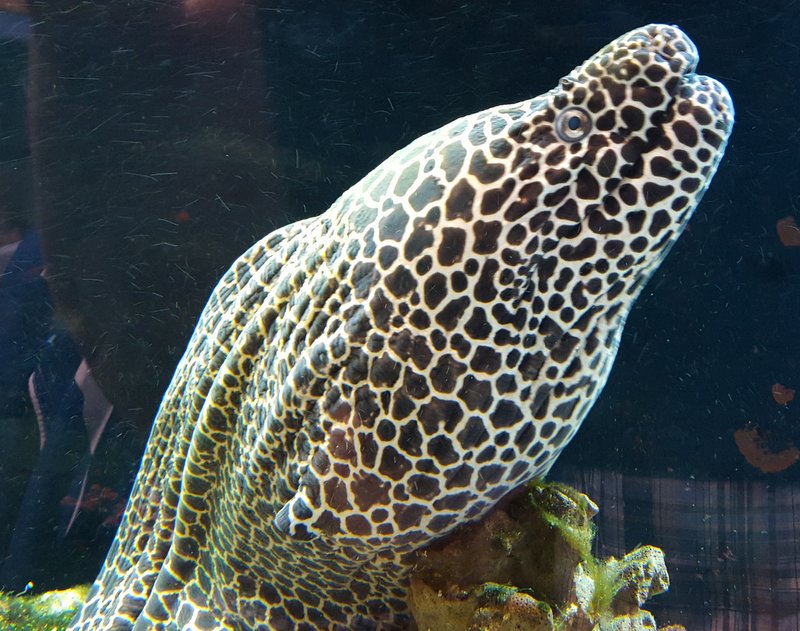
The star of the small-town aquarium is Marley the Eel, the five-foot leopard moray eel. Both Mark and Moray are smiling for the camera.
We had to include a close-up of Marley's head to show his beautiful markings. When he opened his mouth, we could see that he has the same markings inside as well. After seeing some close-ups of very unusual fish, we have to agree that God has quite a sense of humor when he created them.
When we entered the aquarium, one of the locals told us about a contest that was taking place that afternoon. She invited us to taste and then help judge the different savory fish soups that the contestants had made. We were happy to help with the judging, and enjoyed the seven soups served by seven local queens.
We had already spent more time in Rockport than we intended, but then we heard about a concert on the beach at Fulton. Of course, we had to stop for the music, which had been moved inside because there were chances of rain today. We didn't get any rain, but we were glad to be inside because it's easier to two-step on the hardwood floor rather than the sand on the beach.
In between bands, the Fulton Volunteer Firemen put on a display for the crowd. They approached the burning ball of flames from behind a shield of water. Who knew that practicing fire-fighting was a spectator sport?
So we left the motor home around noon today, expecting to be back in a couple hours. But we just kept finding new nuggets of fun that we couldn't pass up. Little towns can be big fun, and all of it was free!
We are learning about the plight of the whooping cranes while we are visiting this area of Texas. In the 1960's there were only 17 whooping cranes left in the world, so they have been on the endangered list for many years. We have found that the largest flock of wild whoopers spend their winters in this area. It's pretty cool to have endangered species for neighbors!
A group of whooping cranes has taken up residence across the road from "The Big Tree" that we visited earlier. It's actually a pasture with several resident cattle that probably don't appreciate their endangered neighbors as much as we do.
One of the reasons they like this field may be the pond and creek running through it. It also doesn't hurt that a local family has a corn feeder providing easy meals for the birds.
We found it was great fun to check on the birds every time we left our park. There were always several other vehicles just like us--parked on the side of the road with binoculars poised to watch every move of the whoopers.
Unlike chasing tiny song birds, it's easy to spot a whooping crane. These birds are five feet tall and bright white, so they are easy to see from a distance.
It's amazing to us that we could see six of these endangered birds in one pasture. Considering that there are only 308 of this wild flock in the world, we think they are pretty special. We even caught one in flight over our heads. Their 7.5 feet wing span makes them easy to see in the sky. These large birds must be great flyers since they will fly over 2500 miles to their mating grounds close to the Arctic circle in the spring.
For all the time we spent watching these whooping cranes, the tiny pictures above were the best our camera could do. So we also took a picture of this stuffed bird at a local visitor's center to show the detail that we could see through our binoculars.
But there are other birds in Goose Island state park, and Denisa wanted to learn about them. She was up early to get ready for the early morning ranger-led bird walk. We don't often include sunrise pictures, only because we don't often see them. God painted a beautiful sky to welcome the morning this day!
The first bird walk was at the pier to learn about shore birds. When the leader asked everyone to introduce themselves, we found that our fellow walkers ranged from intermediate to almost expert birders. I guess they weren't impressed when we said that our expertise was limited to verifying that something with wings and feathers must be a bird. They were especially not impressed when Mark added the only bird he could identify was fried chicken. They let us go on the bird walk anyway. We have seen lots of brown pelicans, but it's hard to get a picture of one in flight.
It was cold this morning, especially with the winds off the water. Denisa had to break out a wind breaker and gloves to watch the birds.
This is one of our new favorite shore birds--a willet. He is a favorite because he doesn't mind standing still for pictures.
They are also valuable for their role in beach clean-up. This willet is munching on a white jellyfish that was beached that morning.
Besides bird-watching, we also did some jellyfish watching. There were several in the clear shallow water of the bay.
Our bird-watching leader also pointed out a flock of skimmers that seemed to be standing at attention for us.
That big beak is great for flying low over the water and skimming small sea creatures for lunch.
The next photo pictures two different shore birds. We learned that the black birds with white beaks are coots, and the two birds on the right are redhead ducks. We're sure there is a joke in there somewhere about the old coots chasing the red heads. We didn't get a picture, but there are also birds called loons in this area. So our retirement has dissolved into spending time with old coots and loons while we are on the road.
Our first day at the island exhibited calm conditions with water without ripples. This morning this pair of pintail ducks were partially hidden by the choppy water in the bay.
We are also seeing lots of herons practicing their ability to stand completely still in order to blend into the foliage at the edge of the bay until some tasty morsel swims by.
When these herons take flight they look and sound like something prehistoric.
Another bird we encountered on our walk is called a Turnstone. Amazingly enough, that name was given because of their habit of flipping over rocks on beaches in search of food. It's amazing how some bird names actually make sense.
We have determined that we are duck fans. We have also determined there seems to be hundreds of different ducks in this world. This would be a scaup.
After five days and seeing thousands of birds at this state park, we realized we hadn't seen even one goose. So it is still a mystery to us why this great state park is called Goose Island. But we feel blessed to get to spend five days here, and we were very happy that they made room for us to stay for the weekend after all. Our camping site in the woods was great, with a view over the meadow. We had some neighbors, but they were very quiet and agreed to be photographed.
We would highly recommend a stay at Goose Island!
We must be crazy RVers, because it's January and we headed further north to new territory. We moved close to two hours north and got this view of the USS Lexington parked in the port as we drove through Corpus Christi.
Because our Texas State Park pass is still valid through the end of the month, we are heading for a stay at Goose Island State Park. Once we crossed the causeway bridge, we headed through a forest of windswept live oak trees towards the park. This view of low hanging limbs is not a welcome sight for people approaching in a tall motorhome. It was nice to know that other RVs have passed this way in front of us.
We could have chosen a camping spot right on the coast. But there are storms and high winds predicted during our stay, so we opted to hunker down in one of the more private spots in the woods instead.
These RVs on the water get a great view of the bay, but don't have much privacy. They also have no shade, and no protection from the wind or the salt water.
But the day we arrived was absolutely beautiful, and a bike ride along the water was a perfect way to spend our first afternoon.
At the end of the bay is a very long pier that gives one the chance to walk over the water. The water was unusually calm this day, and the locals told us that they seldom see it this way.
We learned that "oyster bars" are not places to drink alcohol and eat sea food. They are actually little islands in the bay made out of oyster shell. We have also learned that the shells can be very sharp, and aren't a good combination with an inflatable kayak. This oyster bar was adjacent to the pier, and allowed Denisa to walk out in the salt water without even getting her shoes wet.
New friends took this picture of the two of us at the end of the pier on our first day at the park.
There are always people fishing off the pier. We made several trips for walks here, but this was the only fish that got landed while we were watching. Not familiar with salt-water species, we found out that this is a twelve-inch sheepshead.
We also took a bike ride to "The Big Tree." Several miles outside the park, this tree has been growing in this spot for over one thousand years. The tree's trunk is over 35 feet in circumference, and it spreads 89 feet at its crown. It has withstood hundreds of hurricanes, and the fires the Union soldiers set in this area at the end of the Civil War. The stories it could tell!
These two pictures of "The Big Tree" are from two different angles. If you look closely at the one below, you can see the resident guard cat on the top fence rail to the right of Denisa. We must have passed inspection, as the cat allowed us to stay for a while.
It was a great bike ride along the bay and we are loving Goose Island already.
We were hurrying home because the sun was low in the sky as we biked back to the motor home. We were blessed with a flock of roseate spoonbills just overhead. The picture didn't capture it, but these big birds look a lot like flamingos whose bills have been flattened into a long spoon. We know we are a long ways from home when we see pink birds in our sky. We are witnessing more of God's wonders!