Just a few miles down the road from our campground in Clovis, New Mexico, we crossed another state border into Texas. Just like the welcoming sign, we are driving friendly--the Texas way. We were also crossing into the central time zone. We lost an hour moving time zones, but gained an hour with the daylight savings time change. So we didn't even have to change our clocks!
It seems that as soon as we crossed the Texas state line, the dairy farms turned to feed yards. As we drove through towns with names like "Bovina" and "Hereford," we would agree with the sign that proclaims this as the beef capitol of the world.
As we drove across the flat high plains, it's hard to imagine that the country's second largest canyon is right in front of us. We have arrived at Palo Duro State Park!
We stopped at the ranger station to pay for four nights of camping, then headed down into the canyon. The warning sign lets visitors know they are going down at a 10% grade.
It is a narrow, winding, steep road, but is definitely do-able for RVs. We were glad that we didn't meet anyone coming out of the canyon on the switch-backs.
There are four different campgrounds at Palo Duro Canyon. We chose Mesquite--the furthest from the entry and perhaps the prettiest. Our first assigned site wasn't level enough for a motor home, but we really liked our second site. The only thing we don't like about Texas State Parks is that they assign the sites when you enter. Changing it meant a drive all the way up to the entrance at the top of the canyon wall.
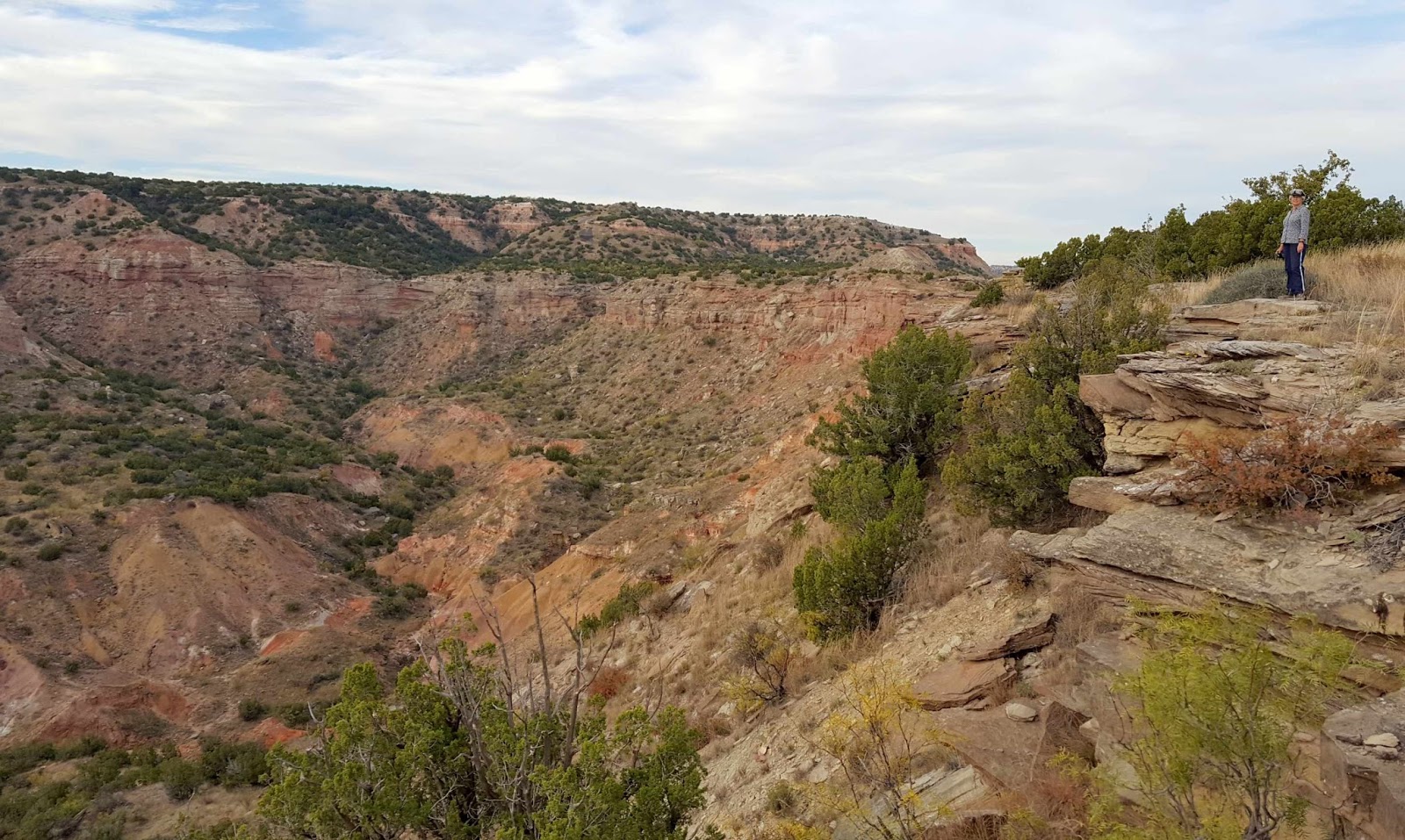
While we made that drive, we also took one of the hikes close to the entrance. You can do this hike from the top or the bottom of that 600-foot-tall canyon wall. Because we like mountain climbing over canyoning, we drove to the bottom and then hiked up. Then it felt like we were mountain climbing! This gave us a birds-eye view of the amphitheater, seen in the bottom left corner in the picture below.
In the summer, a talented cast brings to life the play "Texas" in this amphitheater. We saw it 28 years ago. We know the year because our oldest son was just a year old at the time. Mark's delightful cousin, Matt, lives in Canyon. He offered to baby-sit not only our son, but our nephew as well. We still laugh at the picture of him holding a howling one-year-old in each arm while we were enjoying the play. We got to visit Matt, reminiscing about that trip. He hasn't had a baby-sitting experience quite like that one in the last 28 years.
The hike took us to Goodnight Peak, for some of the best views of Palo Duro Canyon. Most people would be content with this view at the summit of the hike. But not Mark--he was looking longingly at that unobtainable peak over his right shoulder.
Yes, he would find a way to climb down off the steep ledge to get closer.
Yes, he would climb across the ridge. So he is standing next to the sheer wall that should prevent him from getting to the top of that next level.
Yes, he would make it all the way to the end of that tricky scramble. You can barely see him proudly standing on the edge of that "unobtainable peak."
Since he took a camera with him, he could take a picture back towards where the sane people stop hiking. That's Denisa standing on the peak where everyone else would be happy to stop.
The only thing harder than scrambling up to that peak, is finding a way to get back down. While Mark was working on that feat, Denisa took pictures of the "Spanish skirt" rock formations at the bottom of the canyon.
We continued our hike on the CCC Trail, named for the work done in the 1930's by the young men of the Civilian Conservation Corps. They built many of the trails and cabins still used here at Palo Duro Canyon.
We hiked all the way to the top of the canyon and the end of the trail, then looked through the museum housed in another CCC building. We had to hurry back down to the bottom of the canyon, as the sun was getting low in the sky. Darn this time change and these short days. We barely made it back to the car before we caught our first Palo Duro Canyon sunset. I think we're going to like it here!
As we continue our eastern route across the state on Highway 60, we are making our last stop in New Mexico. It was an interesting search for the best campground among many found in the town of Clovis. Because the train tracks run straight through town, we found it's impossible to stay away from train noise. But unusual for us, we made our choice based on television hook-ups. Many times we have gone for weeks without television, but Mark really wanted it this weekend. So when Bolt Campground offered to change up their cable line-up to include Fox Sports 1 just for us, that determined where we would camp in Clovis. Mark was a happy camper because that meant he got to watch the very exciting Oklahoma Bedlam Game while we were staying in Clovis.
Denisa watched part of the game, but she decided to use the beautiful-weather day to explore a little part of our new town. She explored the Clovis Zoo, just two miles from our campground. It doesn't pretend to be a big-time zoo, but it was entertaining. Denisa's favorite zoo animal is the giraffe, and the two here were very friendly.
They leaned their long necks as far over the fence as possible for close-ups.
They are provided with as much food as they care to eat in their troughs inside the pen. It is interesting that they still get into the awkward lower position and use their very long tongues to do a little grazing on the grass just outside their pen. The grass is always greener on the other side of the fence.
Denisa also liked this camel, who seemed to give an over-the-shoulder smile for a picture.
During our travels this year we have photographed many of the animals she saw at the zoo today. But we have to say it is more fun to get a picture in the wild. It was sad to see these two black bears continually pacing the perimeter of their pen.
For many of the cages, the public is removed several feet by a secondary fence. So it is impossible to get pictures of the animals without the wire mesh.
The free-ranging peacocks weren't behind a fence, but they didn't like to stand still for the best photo opportunities. Denisa's favorite color is that royal peacock blue.
Most of the birds were in cages covered by narrow mesh. Impossible to get a picture of the entire bird, this owl had a worried look when Denisa tried.
We haven't visited a zoo in a long time, so this was a nice place to get a good afternoon walk.
Meanwhile, back at the motor home, Mark didn't miss a down of the entire bedlam game. He doesn't cheer for one team over the other, he just hopes for a close game. Our oldest son graduated from OU, while his wife graduated from OSU. Our youngest son is a loyal OSU grad, while his fiance is an OU alum. We are truly a family divided. The good news is we will always have someone happy with the outcome of every bedlam game.
We enjoy driving the back roads around a new town, and we saw a curious bright orange line on the horizon on this drive.
When we got closer, we found an entire irrigation circle of pumpkins left in the field. Thousands of pumpkins are obviously going to waste this fall. In fact, a small herd of cattle were strolling through the pumpkins, munching on the vines. We're not sure who put so much money into planting and watering this crop, but it was a sadly interesting site to see all those bright orange pumpkins still in the field this late.
On our back roads drive, we also discovered that peanut harvest is in full swing. The trailers full of raw peanuts are lined up at the peanut mill in the nearby town of Portales, New Mexico.
The Portales fairgrounds is also home to a large group of old windmills. A local family's collection is waiting to be displayed properly here in Portales, but they already look lovely against the blue New Mexico sky.
Our last stop in the area was at Eastern New Mexico State University in Portales. The Blackwater Draw Museum celebrates the artifacts found in the archaeological dig site in this area.
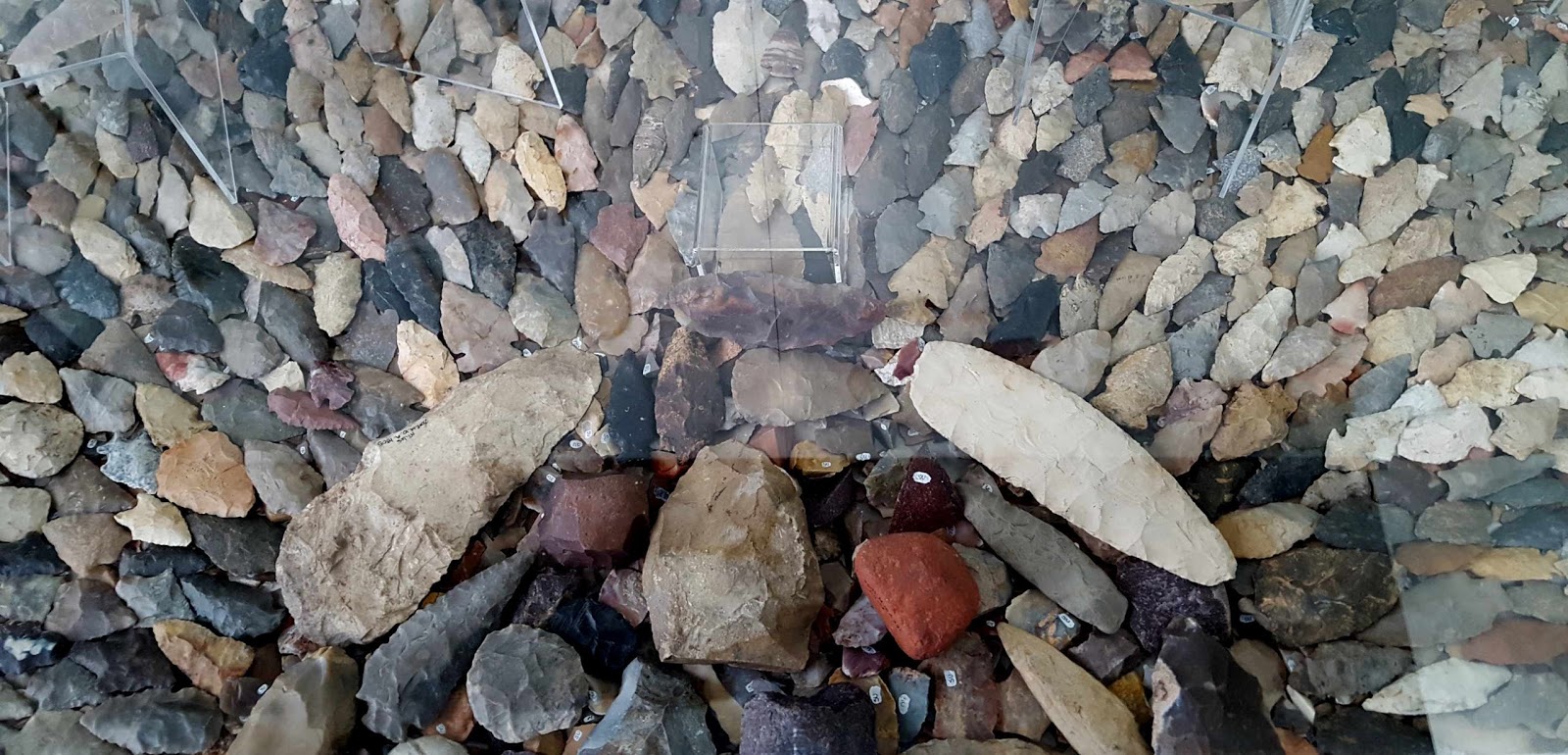
The museum is filled with dinosaur bones and fossils from Blackwater Draw, found between Clovis and Portales. But in another layer of soil they have found a myriad of Indian artifacts. Some times the two are together, as they found mastodon bones with flint spear heads to prove they were hunted here. It's hard to photograph through a glass case, but there were hundreds of flint arrowheads and points in this display. Named after the town where we are camped, the large white piece is called a Clovis point--fashioned by people living in this area thousands of years ago.

Even though we didn't have great expectations for this part of eastern New Mexico, we were pleased with our two days in the Clovis area. Special kudos to Bolt RV Campground for the cable connection for the great football game. The rest of the entertainment around town was just icing on the proverbial Clovis cake. It didn't hurt that the eastern New Mexico sky put on quite a show to finish up our stay. After spending much of 2017 in the mountains and among the tall trees, we are appreciating the sunsets on the plains of the midwest.
After three windy days, on our last morning here at Lake Sumner we got a reprieve. When we woke up and couldn't hear the wind battering the side of the motor home, we got in gear. It's not often that the weather cooperates for a kayak ride in November. But we are enjoying unseasonably warm temperatures today.
The water looked like glass in the cove where the boat dock is located.
It was so calm that we could see the golden leaves of the cottonwood trees reflected in the still water. We've been blessed!
The weather forecast calls for winds out of the west today, so we headed west while it was still calm. Oddly enough, we even had a bit of a breeze at our back as we kayaked down the length of the lake.
We found a gaggle of Canadian Geese as we rowed towards the end of the lake. In our haste this morning, we forgot the good camera. We need to apologize now for the blurry bird pictures today, because the phone just can't take clear wildlife pictures at this distance.
Then we saw an unusual white blur on the horizon. It was a blessing to watch these snow geese circle the lake and settle on the water in front of us.
Just as the weatherman predicted, we watched as that easterly breeze reversed into a westerly wind. As that wind picked up, it was getting tougher to row against it. But we had to get a little closer to get a glimpse of the four sand hill cranes that were strutting on the shore with another group of geese. With all these interesting bird sightings, we certainly were wishing for the good camera that we left in the car.
We had been bird watching our way to the end of the lake, feeling blessed that we got a break from the wind to see so much wildlife here on Lake Sumner. But that predicted westerly wind was getting gusty. We were a couple miles from our put-in spot with a side wind to help blow us home. We could see white caps and waves all the way across the lake.
We got a snow geese fly-by across the blue sky as we made our way towards home. For once we actually planned this kayak trip right, with the westerly winds blowing us and the geese home.
Before the day was over, we also watched as a flock of white pelicans landed on the lake. They formed a long line in the water as they settled in for the night just as the sun was setting.
We've been blessed from the sky and the water today. We're so glad we had some time for the birds on our last day here at Lake Sumner, topped with another great sunset.
We are camping at Lake Sumner State Park, but we found that the lake isn't the star of the show here. Fort Sumner is the reason that most people visit this area. This little town has so many historical secrets! So we made a trip to the fort that is now known as Bosque Redondo Memorial Site. Situated on the Pecos River, this fort was built in 1863 to serve as the make-shift reservation for thousands of Navajo Indians forced to move here.
When we visited the Navajo National Monument in Arizona several weeks ago, we heard about "The Long Walk." That's when the U.S. calvary rounded up the Navajo that were at odds with the pioneers that were settling in that part of the United States. The way to settle the Indian disputes was to relocate the Navajo to Fort Sumner. Many members of the tribe died in the 400-mile forced march known as "The Long Walk." Denisa is listening to an audiophone describing life at the fort.
The soldiers lived in barracks on the grounds of the fort.
The Navajo didn't want to live in the planned stucco buildings surrounding the fort, so they built traditional Indian structures in the fields. Even though our walk here today was lovely, they were miserable for the eight years they were held at Fort Sumner. Now known as Bosque Redondo, the Navajo never return to this place of exile.
As we walked on the nature trail at this controversial location, we found a deer crossing in front of us. She was almost as curious about us, as we were of her.
That wasn't our only animal picture of the day. We also visited the sheep that are raised here at the state historical site. The Spaniards had introduced churro sheep to the southwest, and the Navajo raised them here at Bosque Redondo.
These churro sheep are easy to recognize because the males may have 3 or 4 horns. But it's the females that we are here to see. We found out this little lamb was born just last night.
Another ewe had a new set of twins this weekend. The three of them were all sporting that tuft of white fur on their foreheads. Denisa will say that there are few things cuter than baby lambs.
After the Navajo returned to their homes in Arizona, the U.S. government gave each exiled Navajo two churro sheep to start their herds. So even those cute baby lambs are part of the history we learned today.
As if we hadn't already learned enough history, on the grounds of the fort we also found this marker. This is where Henry McCarty died. Most people won't recognize that name, as he had an alias--William H. Bonney. Most people won't recognize that name either as history remembers him by his other alias--"Billy the Kid." He was shot by the local sheriff right here in 1881.
Billy the Kid is buried in a small graveyard just down the road. His gray headstone is imprisoned in a cage in the cemetery. That's because the stone has been stolen several times. It was found once in California, and another time in Texas. Now that Billy the Kid is locked up, it looks like he will stay forever here at Fort Sumner.
Besides hosting a dark time in Navajo history, and bringing down one of the notorious villains of the day, this little town has a lot of history for visitors like us to learn.