We had read great reviews for the National Park Service cruise to Kettle Falls. Since our friends, Connie and Steven were coming, we splurged on the boat ride ticket for a chance to see more of Voyageurs National Park. We boarded the Amik (that's Ojibwe for "beaver") for our trip across the lake. (If you look closely, you will see that the ranger in the center of the picture is the same "voyageur" that hosted our 12-man canoe ride the day before.)
It's a two-hour trip via boat from the Kabatogama visitor center to Kettle Falls. Our ranger hostess used much of that time to teach us about the eagles we saw around the lake. For example, we know that this is a juvenile because the feathers on the head and tail are still brown.
Some of these young birds were still hanging out around their nests. Reused for many years, these nests can be be 4-5 feet in diameter. Hosting this boat ride several times each week, our captain and ranger knew just where to take us to get the best views of these nests high in the giant pine trees.
The mature eagles are easier to spot in the trees. Their iconic white heads and tail feathers grow in when the eagles are about four years old.
We really appreciated how easy an adult eagle is to spot when they perch on a dead branch with that pretty blue sky background. We would spot 13 of these majestic birds during our cruise.
Meanwhile, our ranger is educating us on the physical attributes of these powerful hunters. Talons like this help them to catch fish as they swoop out of those tall trees into the lake.
An eagle skeleton illustrates the big eye sockets in that bird head. Those big eyes make fishing from the tops of trees possible.
Our ranger also passed around a model of an eagle egg--just a little bigger than a large chicken egg.
Besides all that education, we also enjoyed beautiful views of Kabetogama and Namakan lakes as the miles flew by.
After two hours on the boat, we were glad to stretch our legs on the quarter-mile walk from the dock to the Kettle Falls Lodge.
The lodge was built as a hotel in 1913, but changed hands in 1918 for the interesting price of $1,000 and four barrels of whiskey. It was acquired by the national park service when Voyageur National Park came into existence in 1976. We're not sure how much whiskey was involved in that transaction.
The restaurant is open, and we ordered the signature dish of the lakes--walleye fish. We took a tour of the lodge, including the bar. That was certainly interesting! We tried to take a picture, but we'll just have to tell you that you'll have to visit to see it for yourself. We relaxed on the covered porch, much like people have done for over 100 years.
Just to prove that Connie and Steven were with us, we posed for a picture at the front of the hotel after lunch.
Our tour also included a trip down to the falls of Kettle Falls. We are standing on this beach in the United States. If we turned around, we could look SOUTH into Canada. That's not a typo! If you look at a map, you can see this odd little notch near Kettle Falls where the United States is north of Canada.
We were a little disappointed to find that the falls were commercialized into a dam many years ago. The white water to the right of the picture is the water coming through the dam. It's a beautiful view from the top of the dam down the river.
Under the viewpoint at the top of the dam, we see the U.S. border marker. The international border is actually in the middle of the dam, and the middle of the lake we've been boating on. We had a two-country trip today without even taking our passports.
On our return cruise, we had another two hours to hunt for eagles. This big nest is home to two juveniles--one on the branch to the left and the second almost hidden by the tree trunk on the right.
Voyageurs National Park is a relatively young park, established in 1976. At that time, there were many privately-owned cabins on the islands throughout the lakes. The ranger told us stories about the people that lived here, and pointed out what was left of some of the old cabins.
It was a nice cruise, with a fun ranger and good friends. More importantly, it allowed us to wander through some more of God's wonders here at Voyageurs National Park.
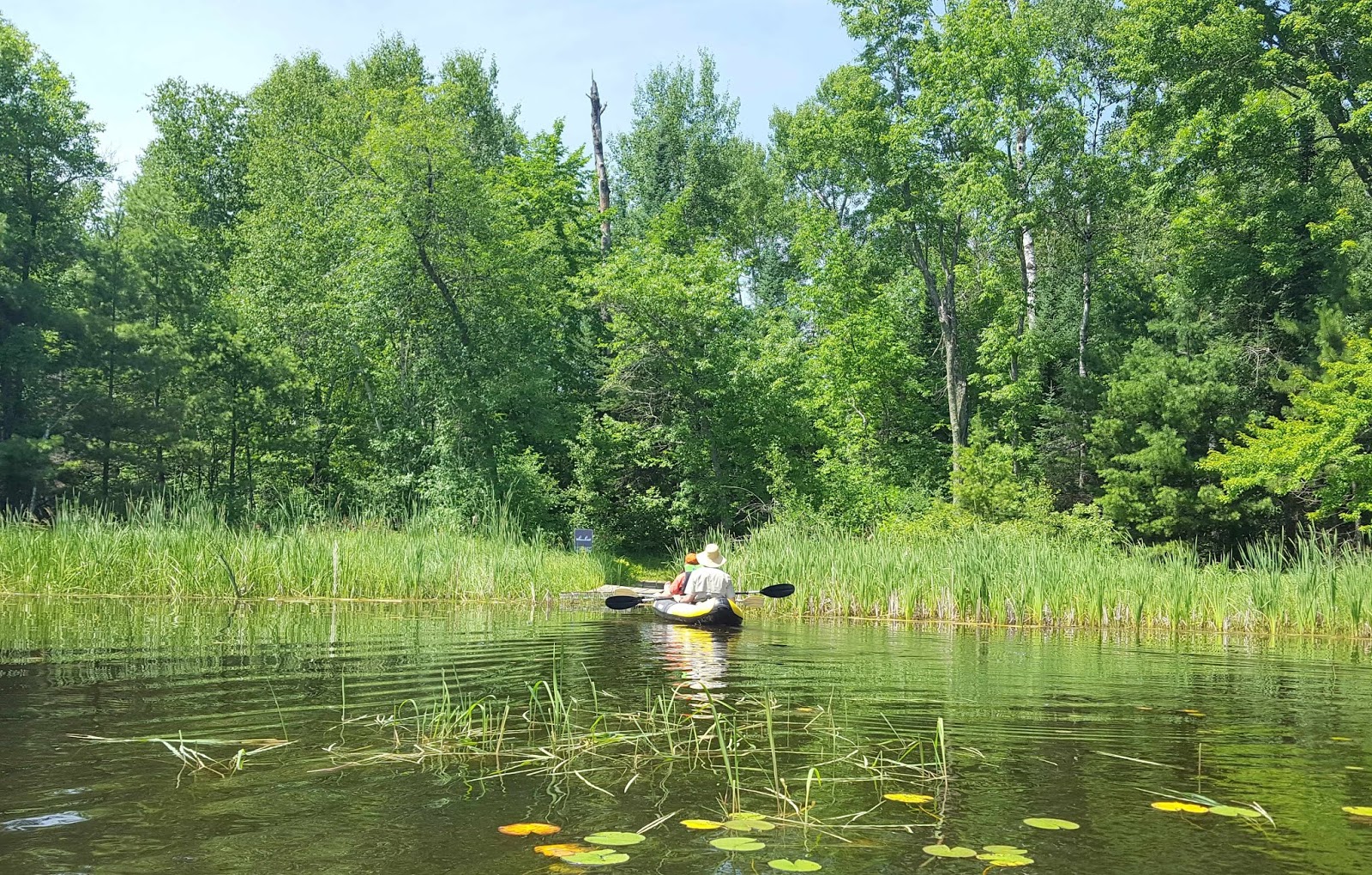
We were delighted that our guests, Connie and Steven, brought their own inflatable kayak when they came to visit us at Voyageurs National Park. Situated on four huge lakes with 655 miles of shore line, visitors to the national park just have to get on the water to really experience it. We made the drive to the second visitor center at Ash River, and inflated our boats for a day on the lake.
Remember that this is Connie and Steven's first-ever kayaking experience, and we have a big day planned. Even though we drove 20 miles to get here, we are still on Lake Kabetogama. That's the same lake where our motor home is parked. This is a big lake! It's a good thing we had a map and GPS, as we are headed towards Lost Lake.
It took some navigating, but we also found this grassy entrance into the Lost Bay Slu.
This is where the new kayak owners also got their first experience at portaging a boat. The trail was full of roots and rocks and poison ivy. With her sprained ankle, Denisa is having enough trouble just walking in such an environment. So she was worthless at carrying a boat. So Mark did double duty--carrying the back end of their boat and the front of ours.
It's a little suspicious that Denisa can't carry a boat, but she can stop to take pictures of these interesting flowers along the trail.
Carrying the back end of a boat means that you can't see the rocks and roots at your feet until you trip over them. After a quarter mile of that, the trio finally arrived at the end of the portage.
 After rowing alongside Round Bear Island, we are now in Lost Bay. Notice that our friends have switched head gear. Steven is making some kind of fashion statement wearing Connie's beach hat, but he's enjoying the extra shade it provides.
Denisa loves berry picking on the trail. But we don't think she's ever found berries ready for the picking from a kayak.
This red raspberry bush was growing right out of the rocks, and at just the right height for a nice fruit snack break. She even shared her raspberry harvest with her friends.
Speaking of rocks, the rocky coastlines are beautiful. Lake Kabetogama is clear because it has a rock bottom. Many of the islands found in the lake, have rock cliffs.
By now it's after 3:00, and even with our raspberry snack we're getting hungry for lunch. There are over 500 islands scattered throughout Voyageurs National Park, and we randomly picked one to beach the boat on so we could eat lunch.
If you look carefully at the bushes in the picture above, you will see that our random little island just happens to host a bumper crop of wild blueberries.
We climbed up to the top of our little island, where the view of the watery scenery around was spectacular! You won't find a dinner view as good as this one in even the most expensive restaurant.
After we ate our picnic lunch, Denisa cajoled everyone into picking enough wild blueberries for a cobbler. The four of us filled two empty water bottles with fresh berries in little time.
While searching our little island for the best blueberry bushes, we also found a nest. The good-sized egg shells were still in the nest. We're hoping this is evidence that the baby birds hatched successfully rather than the nest was raided before they hatched.
We dubbed our favorite island of the day, "Blueberry Island" as we reloaded into our kayaks and rowed away.
It was a beautiful day in Voyageurs National Park, as we paddled by one lovely island after another as we made our way down Lost Bay.
We love the rocks and the water and the trees. The views from water level in a kayak are awesome, and we realize we have wandered into another of God's wonders here on Lake Kabetogama.
Tent campgrounds are spread throughout the islands of the park. Reservations can be made on-line for a camping site that includes a picnic table, fire ring, bear locker, and a private toilet. Day-use areas are also scattered around the park, and we stopped at this one. Behind a one-sided screen we found this toilet. It was a unique experience using a toilet that was in the middle of the woods without walls around you.
At the day-use stop, we traded boats with our friends for the rest of our journey. Our oars are a little longer, and our seats are a little more comfortable. They have been troopers to make such a long kayak trip on their first attempt, so we thought their backs might enjoy a different chair with more support.
We took some wildlife pictures as we made our way by kayak. This tiny frog was enjoying blueberry island as we loaded back into our kayaks.
We saw several eagles today, but most of them didn't want to be photographed. This guy was sitting close to the water's edge, eyeing the fishing options.
We also love to find the Minnesota state bird cruising the water. This lone loon wasn't calling out, but we have enjoyed listening to the loons at night from our campsite near the water.
Later, we would wash up our harvest of blueberries and admire them. This is around 6 cups, more than we will need for a blueberry crisp. We've seen these precious berries for sale at the local store for $14 per quart. We're pretty sure we picked $20 in berries today.
The four of us used most of those berries to bake up a blueberry crisp. It was a nice treat warm out of the oven with ice cream, and we had enough to share it with our next-door neighbors too.
So our first kayak trip at Voyageurs National Park was a great success. We paddled somewhere between six and eight miles. It's a form of exercise that Denisa's ankle will cooperate with, and we reaped the sweet rewards of the local blueberry crop. We have wandered into another wonder, and it's fun to share it with friends!
When we headed north this summer, one of our main destinations was Voyageurs National Park. We are a big fan of national parks, and this is Minnesota's only one. Situated on the very northern border of the United States, it's a less-known and less-visited national park. We hadn't heard of it ourselves until we got a map and started researching all the national parks we could visit as we wander the United States. A two-hour drive from our last campground brought us to Birchwood Resort, where they have two RV spots for short-timers. We signed up for a week's stay. The resort includes a few cabins and few more RV sites with some very friendly neighbors. Shortly after getting the motor home set up, we were down at the dock overlooking our new home lake.
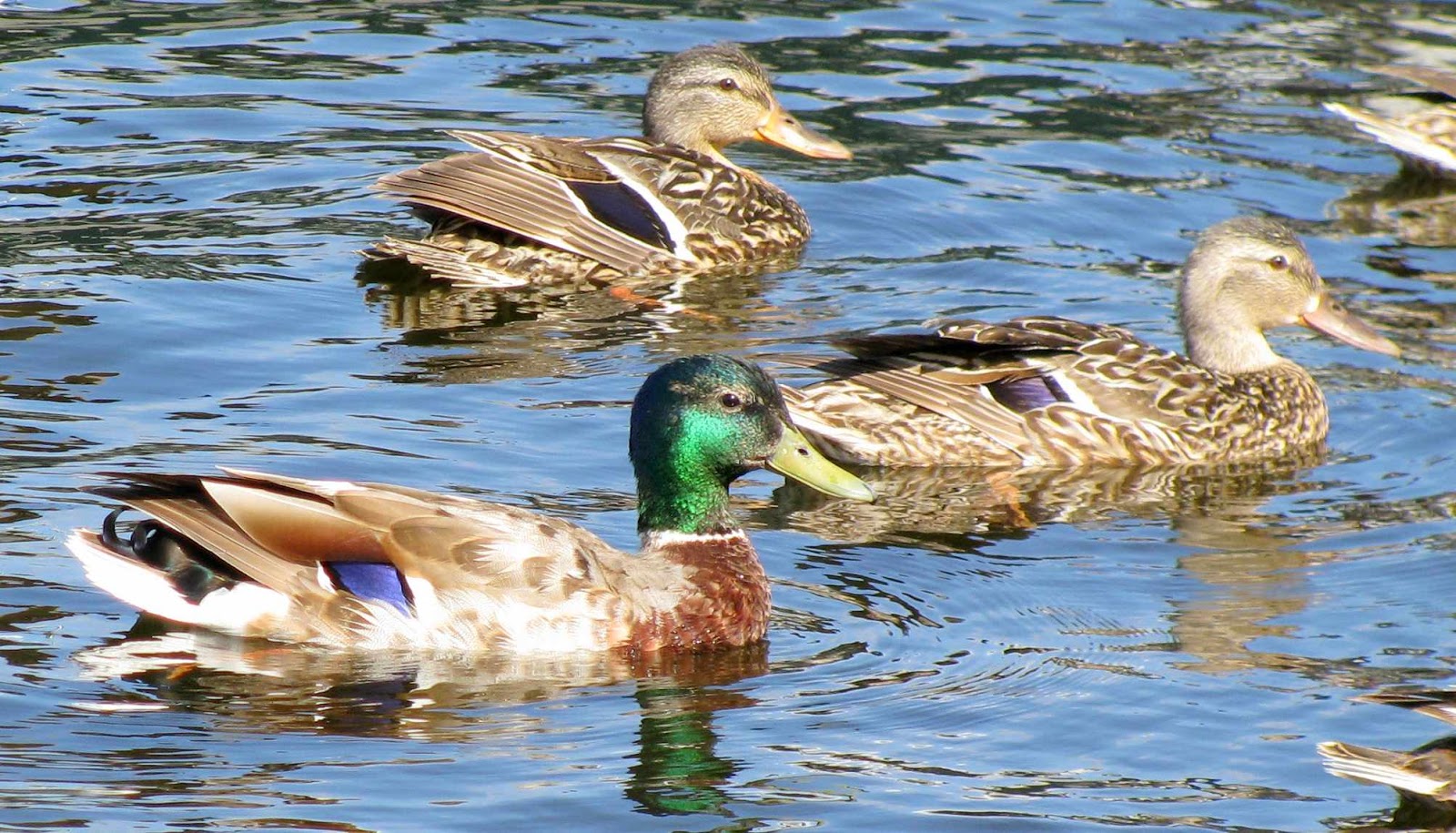
We didn't have to look far for our wildlife picture of the day. The dock is home to a good group of mallards.
This beautiful fellow seems to be in charge, escorting a harem of ladies around the dock.
We hadn't been here long before our guests arrived. Our good friends, Connie and Steven, have joined us on our travels before. When they saw their planned vacation time matched our national park stay, they made the 19-hour drive to meet us for Voyageurs National Park fun.
On their drive here, they stopped to purchase an inflatable kayak. We pumped it up as soon as they arrived, and Mark and Steven took it out for its maiden voyage.
Once the guys proved that it was seaworthy, Connie and Steven tried their hand at rowing together--something that can test even a 35-year marriage.
Having a boat in the water allowed us to take a water-view picture of our new home for the week. Welcome to Birchwood Resort--situated on the watery edge of Voyageur's National Park!
Now that the introductions are over, it's time to learn about this National Park. It's named "Voyageurs" after the men that sailed these waters many years ago. These men rowed long birchwood boats to transport the trading goods to settlers in the rugged north woods. On the return trip, they would transport the furs and pelts that the northerners had trapped all winter. Two rangers were dressed in the usual garb that a hardy voyageur would wear for these long trips on the water.
We were signed up for a national park program where we were playing the role of new voyageurs. We were outfitted with the signature belt worn by seaworthy sailors.
Now the rangers must teach these new recruits how to paddle and follow rowing commands. We got a quick orientation on the dock before we boarded our 26-foot canoe.
Once loaded and schooled, we were off on our journey to the northland, working those 16-hour days that were necessary to make the long trip across the lakes. The trail to the north includes the four large lakes that make up Voyageur National Park.
Actually, it was more like a 30-minute spin around the bay just outside the visitor center. You might be wondering how we got these great pictures of the four of us in the boat. Well, we met a nice couple from Kansas, who were on a road trip with their three grandsons. When we saw them taking pictures of the boys in the boat, they agreed to email us copies as well. Thanks to the Edwards' for the boat pictures!
Now that we know where the national park got its name, it's time to learn how to pronounce the lake at our front door. There are actually three visitor centers, but we are camped on Lake Kabetogama and closest to the Kabetogama Visitor Center. By the end of our week-long stay, we hope to be able to pronounce our lake's name. If we remember that it starts with "cab" and has a "toga" in the middle, it's easier to get the rest of the syllables pronounced correctly. If that doesn't work, we can always shorten it like the locals to "The Kab."
We also found out that this lake is home to the walleye--one of the best-tasting fresh-water fish in the world. Most of them aren't quite this big, but we had to stop for pictures at this statue just down the road.
We already think we're going to love our new home on Kabetogama Lake here at Voyageurs National Park, and we hope our guests enjoy it as well.