We're always looking for a good festival to attend each weekend, and Mark found a gem in the tiny town of Stromsburg, Nebraska. We went to the Swedish Festival where we were greeted with a Swedish "Valkommen" (welcome) and found children dancing in the street decked out in the colors of Sweden's flag.
The town park's sign declares that Stromsburg is the Swede Capital of Nebraska, and most of the events were held within easy walking distance of that park.
Our first event was the children's tractor driving contest. Those traditional John Deere riding toys have been specially outfitted with a weighted box on the trailer they are towing.
As the children pedal further, that weight travels higher up the trailer ramp. It becomes heavier until they just can't pedal any further. The boy and girl in each age division that goes the farthest before their legs give out win trophies.
Tractor contests aren't just for the kids, as we witnessed our first-ever Swedish tractor pull. Four contestants each have a rope to help pull that tractor from its standing position to the finish line down the street.
They had tractor pulls for adults and children, and it was harder for the little guys to get those wheels rolling down the street.
Giving it their all, we saw more than one competitor hit the brick street trying to move that tractor as fast as possible. In the end, "Pappy and the boys" (pictured in the first picture) won the tractor pull by a fraction of a second.
We found another activity unique to this festival when we met Dan at his escape room booth. He had fun brain teaser puzzles for the festival-goers to try to figure out. But he was also selling tickets to a traveling escape room set up at a local church. We enjoy meeting new people as we wander, and Dan and his wife Linda are delightful ambassadors for Nebraska. We enjoyed their escape room, where we worked together to unravel puzzles.
Our Swedish experience was not limited to the town's park, as we also rode the free tour bus to see other historical sites around town. Stromsburg was settled by a group of Swedish emigrants, including our bus driver's grandfather. He told us the town's five churches all conducted Sunday services in Swedish until the 1920's. Our tour included jokes about the traditional Swedish comic pair of Lena and Ole, told by the festival queen on our tour.
We're glad to see that they didn't forget the food at this festival, and we ate the Classic Swedish Plate for lunch. That would include Swedish meatballs and gravy, potato bologna, parsley potatoes, lingenberry salad, Swedish rye bread, and Swedish cheese dessert topped with lingenberries.
We had non-stop activities all afternoon until the parade started at 6:00 p.m. We were glad to see the Swedish theme continued in the parade . . .
mixed with the agriculture that drives this community today,
and a touch of the horse-drawn agriculture from yesterday.
The music provided at this festival was exceptional. We especially enjoyed the Wissman family from Nebraska. They have been performing for twenty years with their 13 children, and today's gospel bluegrass performance included the six youngest children and their Father.
After all that wholesome entertainment, we even stayed for the last band of the day, "Beer Money." This was listed as a street dance, but we were the only two dancers in the streets of Stromsburg this evening.
We stayed at the dance until the sun was setting behind the carnival on this beautiful summer evening.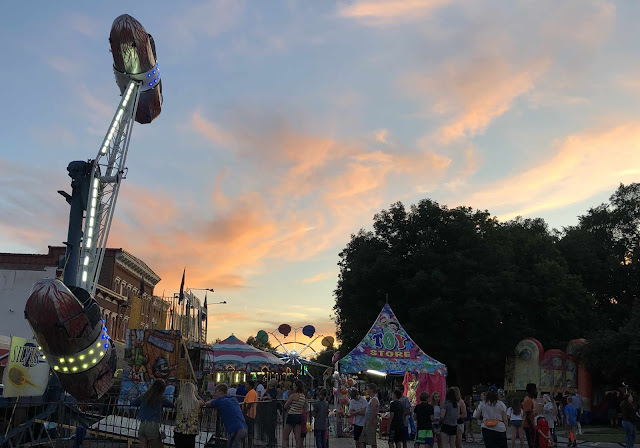
The beautiful weather and the welcoming culture made for a very enjoyable festival day for us. We're even looking a little Swedish as we enjoy the Swede life in Stromsburg!
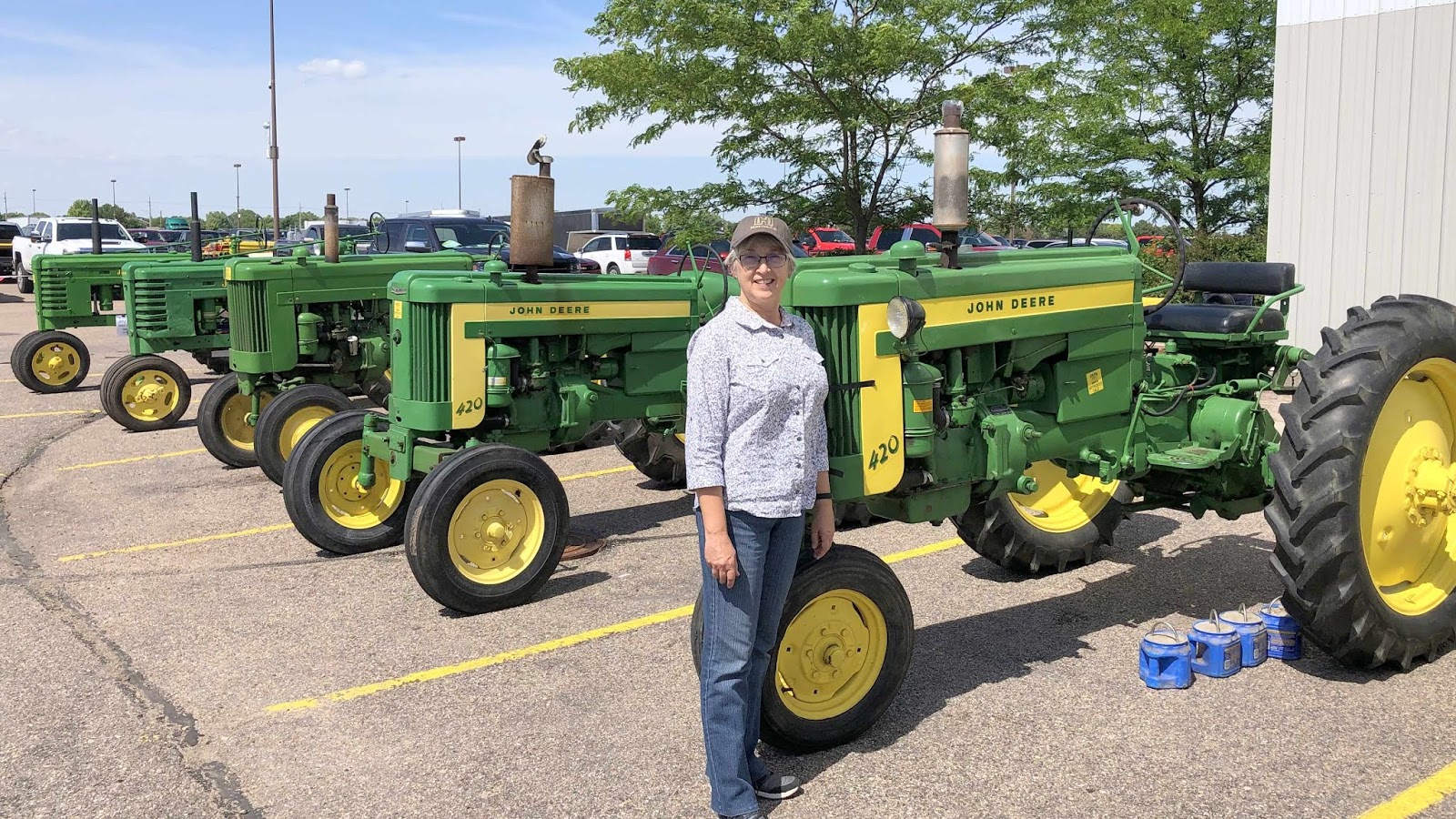
We are camping in Grand Island, Nebraska, because we found a couple factory tours in town. But we ended up finding so much more as we wandered all over this little city. That wandering brought us to the state fairgrounds where two different groups were gathering. It was opening day of the "Classic Green Reunion" where John Deere owners brought their old tractors from all over the country. We saw lines of John Deere green tractors, some of which were for sale. Others were works of love that had been refurbished and were now displayed to make other attendees green with envy.
At the information desk we found that the fairgrounds is also hosting the National Boer Goat show. So we wandered into the livestock paddock to figure out what that meant.
Boer goats are raised for their meat, and their breeders have come from all over the country to determine who has raised the very best boer goats this year. We saw elaborate displays set up by exhibitors, showing off their past success. Many of the owners' booths offered snacks and drinks to entice people to stop to see their goats.
We saw ribbons displayed over boer goats with names like "All Prettied Up" and "Miss Bad Bunny." Then we realized that this wasn't just any show--we were at the NATIONAL boer goat show.
When we approached the arena, we didn't understand exactly what we were seeing. That's when one of the owners invited us to sit down at her table, and she explained the process of judging at this national show. This group of 40 female goats were paraded into the ring by their owners, and the judges in red jackets selected the top ten to move to the center.
Then the judges concentrated on those top ten. They felt their muscles, measured their necks, and watched how the goats moved.
Then they put those top ten into order from first to tenth for ribbons. But during the judging, our new friend also told us her goat story. She described how she and her husband added goats into their cattle operation, and lamented all the expenses of going to goat shows on the national level. One unexpected expense was when we found out that the table she invited us to sit at cost them $500 during this week of shows.
This gentleman is receiving the blue ribbon for his national champion boer goat in her division. We found there are divisions based on age and weight and sex. We also learned that 2,100 goats from all over the country made the trip to Grand Island for this big show that we didn't even know existed until we wandered into it today.
While wandering the Nebraska state fairgrounds we found--you guessed it--the world's largest overalls. Sewn in the 1930s, this 22-foot-long pair of overalls have been hanging out in Nebraska for almost 90 years.
Denisa had read about another exhibit at the state fairgrounds, so we stopped in to see "Raising Nebraska." We were immediately impressed with the big displays designed to teach visitors (and Nebraska residents) about things grown in this state.
We learned lots of things, so we'll share some of them with you:
After going on a combine factory tour, and wearing her hat from the bullet factory, Denisa drove the combine simulator through a field of corn.
Then we learned about chickens in the poultry section of "Raising Nebraska." Have you ever wondered why some eggs are white and others brown?
We milked the mechanical cow and learned about dairies, and the amount of milk each cow produces every day!
While we watched some educational agriculture videos, we should point out that the bench Mark is sitting on is made from other Nebraska products--corn, soybeans, wheat, sorghum, and dry beans.
Hats off to Nebraska wheat farmers so we can eat all those sandwiches!
We were really impressed with the fun displays in this free stop at the state fairgrounds. Good job, Nebraska! Our next stop took us a few miles outside of town to the Crane Trust Nature and Visitor Center. If we were here during the month of March, we could have seen 500,000 sand hill cranes that stop here on the Platte River to rest on their long migration north.
Denisa snapped a picture of a picture of these four-foot-tall birds at the visitor center. We've seen them in south Texas in the winter, but they fly up to 500 miles each day to get back to their breeding grounds up north in the spring. They love the shallow water of the Platte River for a rest stop and to gain strength for the remainder of the trip. It must be quite a sight to see half a million sand hill cranes landing right here!
They also have a genetically pure bison herd on the land surrounding the river. We didn't see any on our walk outside, but Denisa took a picture of these two big bulls inside.
While we were wandering around town, we found another interesting description in a local tourist magazine. It read, "A Grand Island automobile sculptor named Fred Schritt created a garden of fantastic flying cartoon cars."
We didn't know what to expect from that description, but this is what we found. This guy was very talented!
We saw the cars on our way to the Friday evening session of "Hear Grand Island." They close down several streets downtown to host food trucks and live music. What a nice way to end our day in this likable little city!
When we got home, we had just enough daylight to take a walk on the bike/hike trail that goes through our campground. The Stuhr Museum is just across the field from our campground. It is made up of restored old buildings that have been moved to this central location so people could explore them.
Denisa has been admiring that old church from a distance, and this trail brought it close enough for pictures. That dramatic cloud reminds us that we are also wandering God's wonders here in Grand Island, Nebraska today!
We love seeing how things are made, so we are always on the lookout for companies that offer factory tours. We hit the jackpot in the heartland of Nebraska, finding three that we would visit over two days. It's the Nebraska factory tour trifecta! As we left Lincoln, Nebraska, we parked the motor home in the big parking lot for our first factory tour at Kawasaki.
No pictures were allowed on the tour so we have no pictorial evidence, but it was a good one! Our guide showed us around for 1.5 hours letting us touch and see up close the process of manufacturing the Kawasaki products. The picture below is a time line of all the different products introduced here at the Lincoln plant. They started making motorcycles, then grew into jet skis, ATVs, and mules. In the middle of the time line we found out that they also make passenger railroad cars. The final item in the bottom right corner is the latest project--doors for Boeing aircraft.

Our guide has worked for the company for twenty years, and he pointed out the new production line that would soon be making a top-secret new product. We'll have to be watching for that. We ended up in the makeshift museum that includes many of the products that have been built here over the years in Lincoln Kawasaki. That would include ATVs that range in size from two seaters all the way up to ones that can fit the entire family.
After that very interesting tour, we headed on down the highway west for another hour's drive to Grand Island, Nebraska. We settled into a very nice first-come-first-served camping spot at Hall Country Park.
Just like much of the midwest, they've gotten too much rain here in Grand Island. The playground and many of the low-lying picnic tables are under water. All that standing water means we also saw mosquitoes at this park.
After setting up in our camping spot, we headed to another factory tour at Hornady Manufacturing Company. Mark is already wearing his free souvenir Hornady cap outside the visitors' entrance with posts shaped liked bullets.
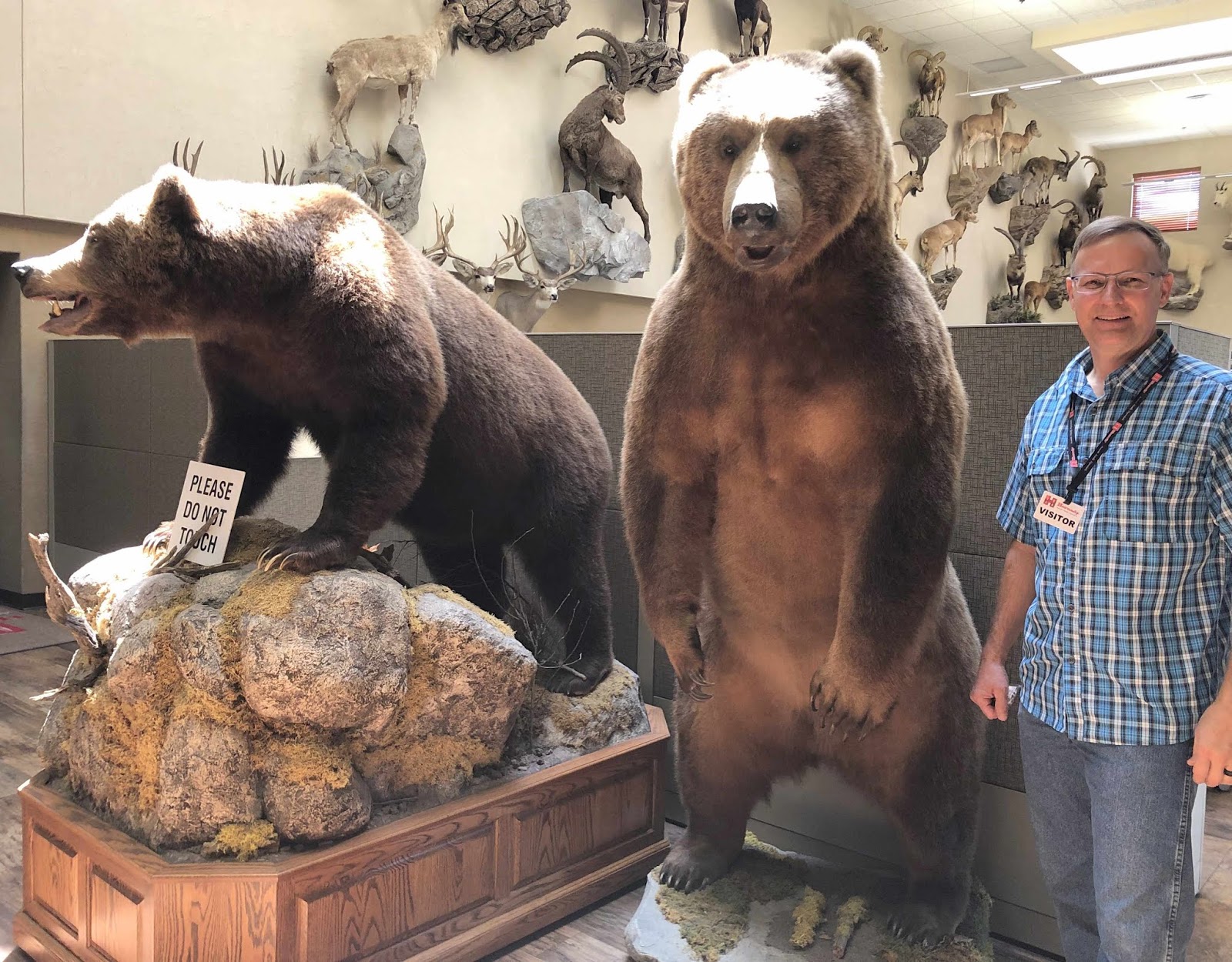
That's because they're in the business of making bullets here at Hornady. Again, no pictures allowed on the factory floor, but we could take as many as we wanted of the stuffed mounts in the lobby and office areas.
The founder was an avid hunter who couldn't find good quality bullets when he started the company in 1949. As you will see, the Hornady family puts those bullets to use on hunting trips all over the world.
Our tour guide took us right beside the machines that were pumping out 6 million bullets each day. We touched the shiny copper casings and watched as they poured the molten lead and then stretched it into bullet cores. It was a very interesting tour!
We're in the middle of farm country, so it's not surprising that our third tour was at Case Industries. We got to watch them assemble combines from the very beginning to the end of the line. Cameras were allowed, so we have pictures to prove we were on this tour.
Just like the other tours, we were provided protective eye gear. But at Case we were also given reflective vests, hard hats, and even steel-toed slip-ons that went over our shoes. They had a hard time finding some small enough for Denisa, but these little pink steel toes did the job.
We saw everything from the plates of steel that are laser cut by a computer generated program to get the most pieces from each piece of steel . . .
to the giant presses that curve and bend those flat pieces of steel into the unique dimensional pieces needed to make a combine.
Then we saw those metal pieces, fresh out of the paint shop as they are transported to where they were needed in the factory.
Our tour guide explained that it takes around 7,000 pieces to make these complicated combines. As we walked by the assembly line, we could see some of those thousands of pieces being put into place. While they make many of the pieces here, they get the engines from France, the cab wiring harness from Mexico, the radiators from Belgium . . .
Because it is so massive, the top half of the combine is assembled separate from the bottom half. In the picture below it is being hoisted up . . .
so it can be "married" to the lower section that is just now arriving after being completed in a different part of the factory.
We expected to only see red on this tour, but this plant also builds yellow New Holland combines. The people on the line have to be able to assemble both, as they use completely different parts. That yellow combine is going to cost more. One of the reasons is that the yellow New Holland cover on the right is metal, while the red Case cover on the left is molded plastic.
Our tour guide also explained the large boards overhead throughout the factory. 18 minutes and 19 seconds are left before each combine will roll forward to the next station. So workers know how much longer they have to get everything completed at their station. Also, 9 of the 13 scheduled combines had been completed so far by 3:21 p.m.
We watched as the giant blue robot arm brought the front tire into place so it could be bolted on in the final step. Then this new combine will see its first rays of sunshine as it is driven out of the factory.
We had to give back our stylish tour outfits, but our parting gift was this laser-cut company emblem showing just how intricately that machine can cut metal.
It was a very educational two days of factory tours, and we would recommend all three companies. The Case tour was over two hours long, and we walked well over a mile on that tour alone. We were tired from being on our feet so much. So we have great respect for the workers that stand and do tough jobs all day, every day. Hard hats off to the workers of Nebraska and their companies that made this fun factory tour trifecta possible!