Friday, November 19, 2021

Newfoundland - The fog finally found us!

We think that autumn is a great time to visit the Canadian Maritimes. We had lots of blue-sky days with comfortably cool temperatures to enjoy the outdoors. We were outside enjoying another pretty day when Mark told Cooper that he took this picture of him and Denisa because "you both are so cute." Cooper really didn't like that reason, so he came back with, "We're not cute! We're adorable!" Well all-righty, Denisa liked that retort!

We were outside playing games with Cooper, looking out over their backyard lake and the clear views of the city of St. John's.

But before we left Newfoundland, we also got to experience some of its fog. That's the same backyard view that we enjoyed in the picture above, but this day we were fogged in.

When the lake views are foggy, the ocean views are even worse.

The fog usually happens in the morning, and the day we visited Cabot's Tower it was especially foggy.

In our walk down the path from the top of Signal Hill, we couldn't see the harbor right below us because of the fog.

It would have been very hard to fire a cannon at the approaching enemy ship if you couldn't even see that ship in the fog!

On another day, we made a second drive to Quidi Vidi village, but the picturesque views we enjoyed the first time were lost in the fog. It's a good thing the fish and chips (and the best tartar sauce in the province) were so good even on a foggy day.

One day the skies were clear in the city, but it was completely fogged-in when we made the after-school drive to Cape Spear about 8 miles away. As we started our hike at Cape Spear, we were greeted by the ominous bellow of the resident fog horn.

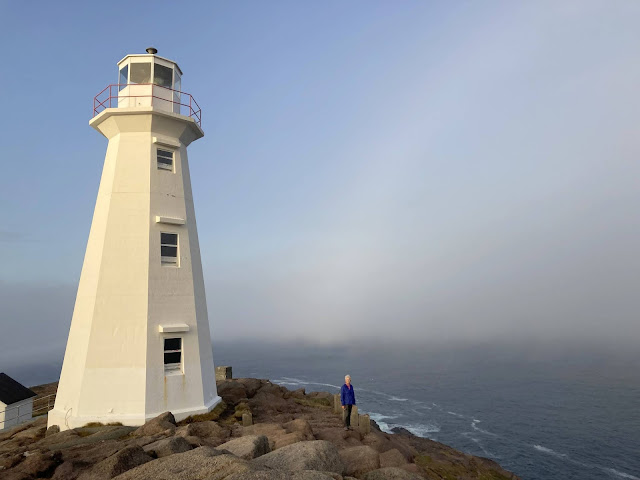
Denisa likes lighthouses, so she didn't let a little fog keep her from getting a lighthouse picture at Cape Spear. 

This is the most easterly point of North America, and there are actually two lighthouses guarding this point. We got a foggy picture of the one built in 1955 (above) and the older one from 1836 (below). This older lighthouse is the oldest surviving lighthouse in Newfoundland. Both lighthouses are built on the high cliffs above the Atlantic Ocean, but the fog prevented us from seeing the water at all.

Cape Spear has been used as a military outpost for years, with interesting fortified tunnels that make beautifully-echoed acoustics when you sing while walking through them. Guess how we know that?

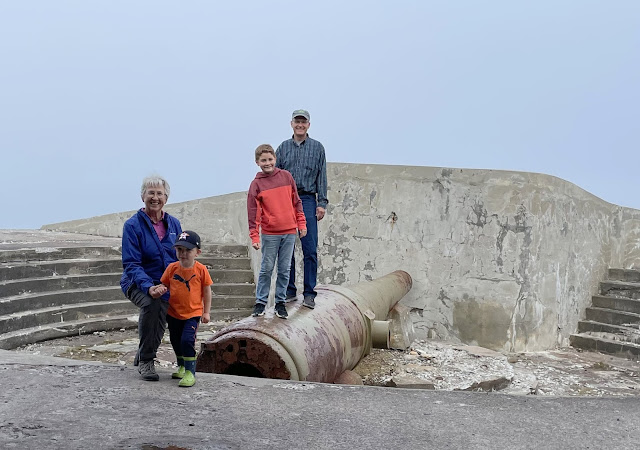
We walked by some of the armaments still in place from World War II,

as well as the jail cells that kept villainous intruders in place.

We watched as the storms causing the fog were bringing big waves to this coast.

We found our last set of red adirondack chairs at this most easterly point of North America, but the fog kept us from seeing the best views that these chairs usually provide.

Just as we were about to leave, the fog started to lift. So Mark and Denisa climbed that long flight of stairs to get a clearer view of the newer lighthouse and the ocean below it.

From here we could see the rugged coastline, and the foggy outline of the old lighthouse behind Mark.

Cape Spear is a beautiful place even with some lingering fog.

On the way back to the city, we stopped at a viewpoint to watch the big waves crashing on the rocks.

Some of us watched from a tall cliff at a safe distance . . .

while others scrambled to the farthest rocky outcropping where the big waves were sending sprays of water into the air high over their heads.

What a beautiful view of the North Atlantic churning against the rocks! We are witnessing more of God's wonders today!

This is our last official outing here in Newfoundland. While planning the trip we were supposed to take last year, Denisa had made a list of things we wanted to see and experience in this beautiful province. All the boxes have been checked beside all the items on her list. We've had a great trip, even if the fog finally found us at the end.

Thursday, November 18, 2021

Newfoundland - Exploring St. John's with the Locals

We know that the island of Newfoundland can have some nasty weather. Its winters are cold and snowy, and it gets more than its share of wind and fog. But Alexia tells us that Newfoundland is showing off for us with all this great weather. So we are taking advantage of another blue-sky day to explore with the locals more of the area close to their house while the kids are at school. We wanted to see Quidi Vidi, a little neighborhood that surrounds Quidi Vidi Lake. In case you're struggling with how to pronounce it, think "Kitty Vitty" while you are reading this blog.

Our hosts have a lovely family picture hanging in their living room that was taken here, and Denisa wanted one just like it. This is such a picturesque little village! We tried taking our picture here . . .

and here . . .

and here. Then Denisa realized that it wasn't just the back drop. Maybe their picture was better because the people in their picture were better looking.

Alexia took us up on the Sugarloaf Path that starts at Quidi Vidi for our hike of the day.

From the trail, we can see this picturesque little village, and the fish and chips food truck where we were planning to have lunch.

We can also see a fishing boat coming in from a day at sea. We talked to that fisherman later, and he told us that the only time boats could enter Quidi Vidi Lake from the ocean was during high tide when there was enough water over the dam for a boat to float over.

We took the Sugarloaf trail until we could see the inlet to the ocean between two big sea stacks. We are getting to wander among God's wonders again today!

Alexia is still trying to get that perfect picture of this imperfect couple!

Quidi Vidi Village Plantation is an arts and crafts incubator shop with a prime spot on the wharf. It was closed on the day we were visiting, but we couldn't hep but notice that many of the rocks in the flower beds had crocheted or knitted coverings.

When we looked closer, we saw that each had a QR code that explained who made each rock afghan.

We're taking advantage of the nice weather to tour some other parts of the city of St. John's with the locals. One of the things that this city is famous for is "jellybean row." These brightly painted row houses remind us of the ones in San Francisco, as do the steep hilly streets that lead down to the ocean.

The jellybean houses are all over downtown, but we found that the electrical wires stringing in all directions made for cluttered pictures of these bright row houses.

We passed the jellybeans on our way to the Terry Fox memorial situated on the harbor. Perhaps you recognize that name, as he was named "Canada's Greatest Hero" in a poll a few years ago. Terry Fox was a Canadian, who was studying to be a teacher and coach when he was diagnosed with bone cancer in 1977 at the age of 19.

The cancer took his right leg, but he continued running and developed his plan to run across Canada to raise funds for cancer research. He started that run on this spot in Newfoundland on April 12, 1980, when he dipped his artificial leg into the Atlantic ocean. He was running toward the Pacific Ocean, and his run was named the "Marathon of Hope." He ran a marathon each day for 143 days before his cancer returned and he was forced to stop. What a heroic young man! Our great-nephew, Cole, was participating in a Terry Fox run at school while we were visiting.

This was also "date night" as the adults have reservations at one of the nice restaurants in downtown St. John's. The Merchant Tavern building used to be a bank, with one special table in the old bank vault.

We were seated at the "wet bar" which means that we got to watch the chefs prepare dishes like Beef Tartare or Snow Crab Clusters, or torch the top of creme brulee.

It was dark outside by the time we finished our dinner of Steak Frites and Cream Corn Agnolotti. We don't often eat at such fancy restaurants, but this is where the locals go! Afterwards, we got to see downtown St. John's all lit up.

Our last stop of the night was the local candy store, with its collection of old-school favorites that we haven't seen in years, and Newfoundland local candy that we have never experienced before. We feel so lucky to get to explore the local sights of St. John's with the locals! 

Monday, November 15, 2021

Newfoundland - The new skills we learned

While we are visiting with our nephew, niece, and their family in Newfoundland, we are also learning new skills. One of our new skills is how to solve a rubik's cube. Brian and Camden were very patient with a couple of old-timers learning a new skill. We took a picture of Mark's first solved cube.

After that, it just takes practice and learning what to do in every cube situation. Here's evidence that we got better at it, as we kept solving their cubes plus the rubik's cube they gave Denisa for her birthday present. We were quite slow compared to Brian and Camden's less-than-one-minute solve times, but it was a fun new skill to learn in Newfoundland.

We also learned Newfoundland history skills. On a trip around the city of St. John's, we visited the Cabot Tower on the top of Signal Hill. This is the site of Guglielmo Marconi's first trans-Atlantic wireless signal all the way from England in 1901. Cabot Tower was constructed in 1898, celebrating the 400th anniversary of John Cabot's discovery of this island. Until last year, this province has celebrated "Discovery Day" in June to commemorate Cabot's discovery. It's interesting that this year, "Discovery Day" is now called "June Holiday" as an act of reconciliation with the island's indigenous population who have been here even before Cabot.

Also this year, Newfoundland is celebrating a new holiday. We were there for the first-ever "National Day for Truth and Reconciliation." For years, the children of indigenous people were taken away from their parents and forced to live at government residential schools that didn't allow their native culture. Because of this new official holiday, school children all over Canada had the day off to "recognize the pain, trauma and suffering that has been caused by residential schools" and "learn more about indigenous people."  We often drove by this fence where each piece of colored paper symbolized a victim of the residential school system.

We are also honing our geography skills while we are in Newfoundland. We didn't know that the most easterly point in North America was on this island. Here we are at Cape Spear where one could see the earliest sunrise on this continent.

We learned yet another geography skill during our visit. Our hosts taught us how to memorize the 195 countries of the world. If anyone is interested, please feel free to call us and we'll recite all 195 for you over the phone. It uses a technique known as a "memory palace" which is a great new skill for us! The following picture doesn't have anything to do with our memorization skills, but it is a beautiful picture of more of Newfoundland's geography. If you look closely, you can see Mark and Camden sitting together in the center of that picture.

In a previous blog we described learning cinnamon roll skills from Camden, and Tres Leche skills from Katrina. 

Cole was trying out for a special choir at his school, and needed to learn a song for the audition. So Denisa learned the new song so she could teach him. That's actually an old skill she rekindled, since she has prepared our son for auditions as well. We're proud to report that Cole was successful, and earned his way into that special choir!

We also developed our skills for using up the wild berries that we picked. We made a big batch of wild blueberry pancakes, and another batch of wild blueberry muffins. They both had more than the usual amount of berries because the harvest is bountiful here in Newfoundland.

We learned a lot of skills while we were wandering about Newfoundland. Thanks to this family that is so generous with sharing their home and their knowledge with wanderers like us!