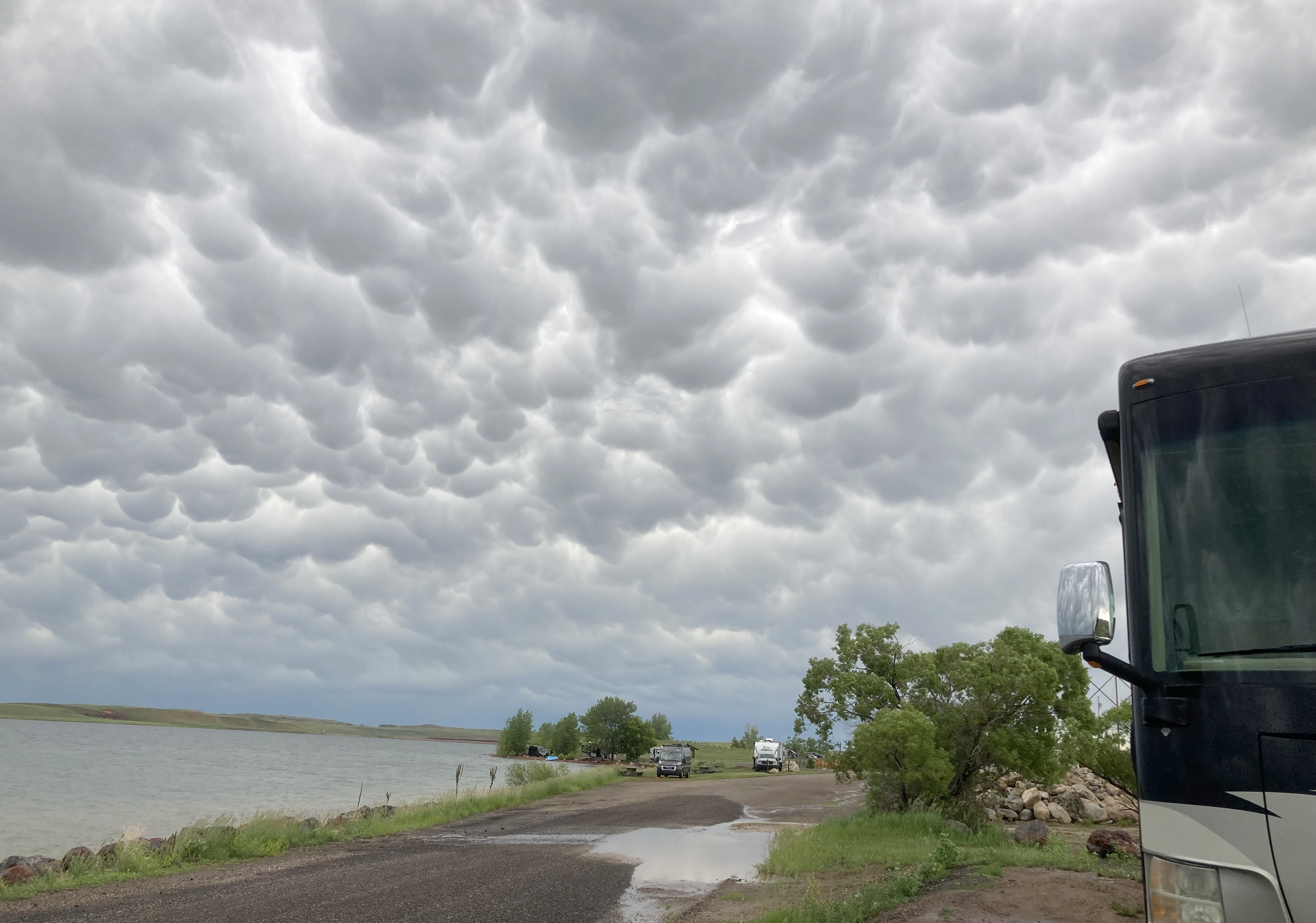
Normally, we like to enjoy the luxury of a full hook-up 50-amp campground until they kick us out of our site at check-out time. But this morning we were up early, eating a fast breakfast and on the road by 8:30. That's because we are heading to a first-come-first-served campground, and we need to get there first. The drive is a little over an hour, but we stopped at the Wyoming welcome center for some information. Mark also got the kayak inspected because every boat of any size must have an inspection sticker before getting on any water in Wyoming. Welcome to Wyoming!
We've been told that they were having an unusual amount of rain around here, but they're not complaining. They would much rather have rain than wild fires, because summer is fire season in Wyoming. We got rain again last night, and the drive was wonderfully green.
The grass is so green that they even bale the bar ditches in Wyoming!
Our first destination in Wyoming is Devil's Tower National Monument, and we anxiously awaited our first glimpse of this unusually prominent rock tower. But we can't stand and gawk at it yet, because we have to get a camping spot at the park's campground. About 15 miles away from the tower, we met four RVs on this remote road. We assumed that they had just left that campground, and that we could get one of those four spots. We were right. When we arrived a few minutes after 10:00 a.m., we were relieved to see that we had several spots to choose from. We got one long enough and level enough for our motor home!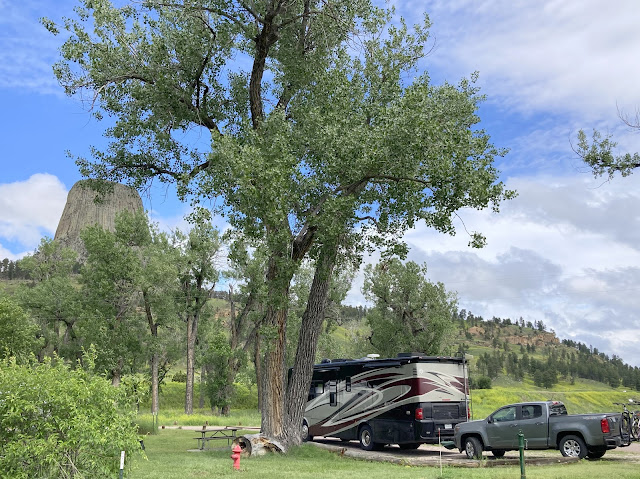
Getting a camping site was more risky this day, because half of the campground was closed to the public. Devil's Tower is a sacred American Indian site, and the national park system had given them one of the two camping loops for their summer solstice ceremonies for the next ten days. It's a challenge to get a camping spot anyway, but it was doubly difficult during those ten days. We were so happy to be settled in for the night! We watched as a parade of RVs circled the full campground later in the day, disappointed that there wasn't a spot for them. This was our view of Devil's Tower from our campground. Now we can stand around and gawk at it!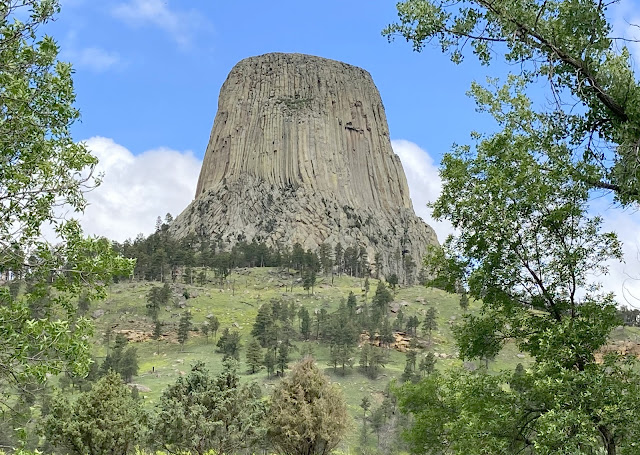
We headed to the visitor's center to get hiking advice, and noticed a portable stop light beside the road. But it was off, so we continued to the visitor's center. We were so surprised at how crowded it was! We drove through the regular parking lot and the overflow parking area several times before we finally found someone backing out of a precious space. We knew camping spaces were in short supply, but parking spaces too?!? Most people that visit Devil's Tower will take the 1.3-mile loop trail that goes all the way around the base of the tower. So we decided to start with that hike. You can see Denisa standing at the base of the tower in the picture below.
Devil's Tower is made up of six-sided columns that have been pressed together. 
From some angles those pencil-like columns are more obvious. The gaps between the columns make it possible for climbers to wedge fingers and toes into slots and work their way all the way to the top. June is a sacred month for the American Indian tribes, and the peregrine falcons are still nesting this month. So the national park service asks climbers to voluntarily not climb the tower in June. That explained why we didn't see any climbers today.
Most people will stay on the smooth trail around the tower and be happy. But Mark isn't most people. He thinks it is fun to climb over the boulder field that has accumulated at the bottom of the tower.
Anyone can climb on the boulders. But going past them and starting an ascent to the top requires a permit. So Mark was allowed to play in the boulders all that he wanted.
Denisa is content to sit at the base of the boulder field and watch her mountain-goat husband play in the rocks. He took this picture of her at the bottom of all those refrigerator-sized rocks he had just climbed over.
In preparation for our trip to Devil's Tower, last night we watched the movie, "Close Encounters of the Third Kind." We took some still pictures of Richard Dreyfuss and Melinda Dillon making their way to a fenced-off Devil's Tower.
By the time the aliens returned in the movie, we felt like we had already visited the tower.
We tried to find the spot where the two Hollywood stars made their way closer to Devil's Tower.
Does this look like the same spot? A young mother took this picture of the two of us non-Hollywood stars in front of the same boulder field.
Then Mark took off again, hopping onto and over boulders while Denisa watched. The young mother made comments like, "He's like a gazelle out there!" and then "Do you mind me asking how old he is?" Denisa couldn't decide if she thought he was older or younger, but she was impressed that an old retired guy could move about those rocks so gracefully.
Since he's wearing a boulder-colored shirt, when he got very far away, Denisa couldn't see him in the camera lens any more. He's out there, but he blends in with the rocks. She tried framing him with a tree. If you look very closely, you will see him surrounded by the top branches of the tree on the left.
As we walked around the tower, the views changed. From this side, we could see "The Window" that was made when a rectangular section of those pencil-like columns fell off the tower.The boulder field is actually made up of chunks of the tower that have fallen. While many will shatter into smaller pieces when they hit the ground, occasionally one will stay in one long column. This six-sided chunk that Mark is standing on had fallen to the ground without shattering.
Walking the entire loop, the tower changes colors and shape, and the clouds kept covering up our blue skies. On the back side, we found a nice rock to stand on to take a picture with the tower in the background. A man offered to take our picture, and he just took it of the two of us--without Devil's Tower in the background. So we asked another person, and got the picture we had envisioned.
What a fun place, and what a good hike! With all of Mark's boulder jumping and rock scrambling, he managed to stretch this 1.3-mile hike into 2.3 miles.
We stayed for the 1:30 ranger's talk, and talked to some of the other visitors. We found out that the traffic light we saw on the road started operating shortly after we passed it. People were talking about how long they had to wait in line on the road just to enter the parking area. Most days the parking lot is full from 10:00 a.m. until 3:00 p.m., and visitors can expect to spend a long time in line in their cars if they arrive during that time. When we left around 2:30, we saw around 100 cars waiting in line just to get into a cue for a parking place.
They do something else unusual here at Devil's Tower National Monument. Cars are allowed to come in for free, but they have to pay when they leave. We didn't leave because we were just going back to the campground, but we saw a very long line in the middle of the day when most people were leaving. So if you arrive around 12:00 and leave around 2:00 in the middle of the summer, you will spend time in long lines in your car coming and going.
We fixed some lunch, and then headed out on another hike straight from our camping spot. We're going to do the outer loop that circles the tower, on a hike called the Red Bed Trail. 
Our campground host saw us leaving down the trail and reminded us to check for ticks when we were finished. We can see how that is possible because the grass and flowers are up to our waist in places.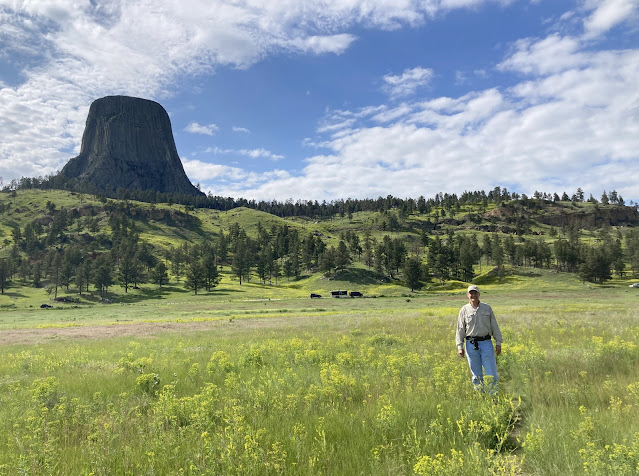
So we heeded his warning, and tucked our jeans into our socks. That's a fashionable way to thwart the ticks' ability to crawl up our legs. So if you wonder what kind of fashion statement we are trying to make, just know that we really hate to find ticks. Our hike started along the Belle Fourche River that we can see from our camping spot. We have been told by a couple locals that you pronounce that river "Bell Foosh." That's not what we would have guessed.
This trail is four miles long, and gives great views of some of the geology that you don't see up close to the tower. These hills have iron in them, painting them bright red.
The entire trail is surrounded by wildflowers. We hiked through a sea of bright yellow sweet clover.
Most of it is waist high and blooming at its peak now.
We were glad to see that the ranger was putting away the "closed trail" signs that we had seen earlier. Parts of this outer loop trail were closed during the Indians' ceremonies. That was to keep people off the high trails that look down over their reserved camp area. So we got to make the full loop this evening on this 4.1-mile trail, rather than having to back-track like we thought.
We saw marmots, but of course we forgot to bring the good camera. So the only wildlife that stood still at close range was a magpie.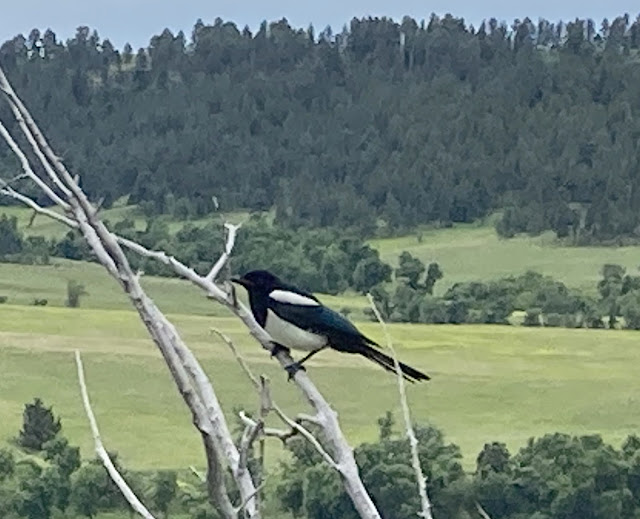
The wildflowers stood still for a picture with the tower in the background.
We haven't seen many purple cone flowers this summer, so Denisa stopped to take another picture (and to catch her breath).
We finished the evening with a drive around the park, seeing Devil's Tower from all sides along the road in the evening light. 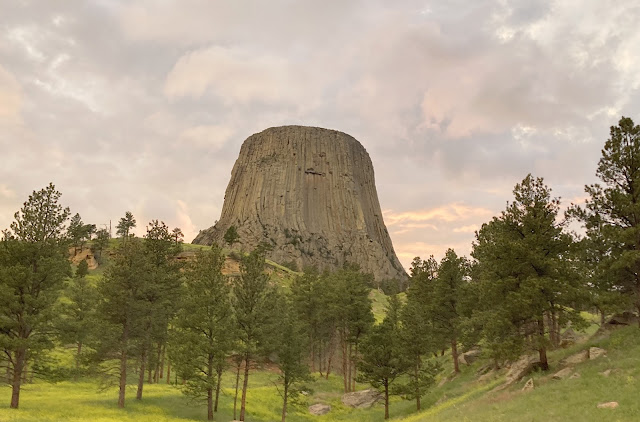
While the clouds were too thick for a remarkable sunset picture, we finished our first day in Wyoming with one last picture of Devil's Tower. We have been blessed to wander around another of God's wonders!