There are 43 "All-American Roads" in the United States, and the Creole Nature Trail is one of those. Beginning at Lake Charles, this 108-mile-loop bends through the part of Louisiana that is affectionately called "The Louisiana Outback." It starts at a new visitor center right off I-10 at Exit 20 in Sulphur, Louisiana. There are interactive displays here, and Mark worked on his crab fishing techniques. February isn't a good month for crabbing, but you can be sure we would have tried it if we were there during the summer.
We also learned about the music in this part of the state. Whether Cajun or Zydeco, both forms of music feature the accordian. This display allowed you to hold the instruments, and when your hands touch them it activates the sound track to include your instrument.
Besides the accordian, cajun music usually includes a steel guitar and a fiddle. By Mark holding the fiddle, we hear it on the sound track.
Zydeco music includes a bass guitar and a wash board, that can also become a fashion statement.
After playing with all the toys in the Adventure Point visitor center, we started our 108-mile journey on the Creole Nature Trail. We were guided by a GPS Ranger that we had rented for free. It tracked our progress on the loop, giving us audio and video narrative about the things we were seeing from our car window.
Our first stop out of the car was the Intracoastal Waterway Park. The bridge behind Denisa can raise to allow taller ships to pass under. This Intracoastal waterway starts at the tip of Texas, and continues all the way to New York. It allows big barges to deliver goods from south Texas all the way up the east coast without having to travel in the open seas. At this particular park there are also 18 RV sites for anyone interested in watching ships go by.
Our next stop was to take a mile-long walk along the marsh. But we saw this billowing cloud of smoke as we approached.
Coincidentally, about that time our GPS Ranger informed us that controlled burns were used to clear the national wildlife area we were driving through. This is done routinely to keep the area healthy for native plants and animals.
Sure enough, we saw a ranger with a flame thrower, setting the tall vegetation on fire as we watched.
They were prepared for this fire, with area fire trucks to keep the electrical poles from catching fire.
We didn't see as much wildlife as we had hoped, but it was a cool day. We saw lots of warning signs about alligators on our walks, but they were all hiding today. The Creole Nature Trail also took us all the way to the Gulf of Mexico, and there were several stops available for visiting the beach. Our first stop was at Holly Beach, an area that has been decimated by several hurricanes in the last ten years.
We love to walk on the beach, and we found the most beautiful shells that we have ever seen on a public beach in our entire lives. Mark's big hands weren't big enough to hold them all, so this was just a few of the shells that we found.
When you live in a motor home, you learn not to keep all those treasures. So we take pictures of our treasures to remember them. Denisa was working on some beach art that will surely wash away with the tide.
This is the finished picture of our very temporary collection of shells for the day. We think Holly Beach is the best place to look for shells that we have ever been blessed to visit.
Another close-up of a hand-full of perfect shells we found today. Seeing so many perfectly formed shells reminds us that the beach is another place to wander among God's wonders.
We stopped at another beach about five miles down the coast. So close, but the shelling was so different here.
Far fewer shells, and different varieties than we had found at Holly Beach. We certainly have a creative God that can design so many beautiful shells!
In order to continue on our loop, we had to take a ferry around Monkey Island at the small village of Cameron.
This little village is just a shell of its former self after being decimated by hurricanes in 2005 and again in 2008. There is a memorial plaque at the court house that explains that in 2005, Hurricane Rita caused a storm surge that breached 30 out of the 40 cemeteries in this parish. Over 340 caskets and their contents were torn from the ground and scattered in the marshes.
Towards the end of the day, we saw more and more birds making their way to their roosting places for the night. This is just a small section of the flock of snow geese that were congregating in the marsh beside the Creole Nature Trail.
But our favorite birds to watch in this area are the Roseate Spoonbills. They are especially beautiful when they unfurl those big pink wings to fly. The picture below is a little blurry, but was our best shot at comparing the pure white egrets to the two pink spoonbills on the wing.
We found out there was a spoonbill rookery behind the the Cameron Prairie National Wildlife Refuge on our nature trail loop. There were as many as a dozen birds for us to watch from a distance.
As the sun was sinking, their pink color was even reflected in the water of the marsh. This picture better shows the spoon-shaped bills that allow them to dig up juicy tidbits to eat from the bottom of the marsh.
We have discovered another of His wonders as we watched these curious birds prepare for night-fall.
We stayed on the viewing deck until sunset, watching as whole flocks of birds flew into the marsh.
It is a beautiful sunset in the Louisiana Outback when the pink setting sun matches the birds.
It was dark by the time we finished the 108-mile loop, and returned to our camping site. We had experienced one of the best scenic roads in this beautifully scenic country we are blessed to explore.
After spending the last two months in Texas, we have finally wandered our way into the state of Louisiana.
When entering a new state, our first stop is the Visitor's Center. There's a nice one at exit 29 along I-10 in Lake Charles, and we loaded up with information. We also got our first look at some of the finery of Mardi Gras.
Right behind the visitor center we could see the body of water that Lake Charles is named after.
We also got a view of an enclosed area that plays host to several of the area's famous alligators. Denisa wanted to warn this turtle that she had seen an alligator eating a turtle recently. But the three of them seem to be on friendly terms without her warnings.
We saw a snowy egret, and actually got a picture of those bright yellow toes. We don't know this alligator's intentions, but he certainly isn't hiding his devilish smile.
We are camped at Sam Houston Jones state park just north of Lake Charles, Louisiana. We are surrounded by water! While walking the river trail we can see the Calcasieu River on one side . . .
and the swamp on the other side of the trail.
We are getting used to words like bayou, swamp, and marsh that describe much of this part of the state. We have learned that the difference between a swamp and marsh is that swamps have trees while marshes do not. A bayou is different from both, because the water in a bayou is moving. So by definition, this is the swamp in our backyard at the state park.
Besides walking the state park trails, we also biked some of them. We thought we had learned our lesson to not to bike in the mud, but you have to expect mud when you are living in a swamp. You also expect signs warning you about alligator nests with protective mama gators if you get off the trail.
We have been exploring the city of Lake Charles. Some of the first citizens of this city are buried in a cemetery beside the lake. We enjoyed the statues in the middle of the very old gravestones.
We walked the historic downtown with its Victorian houses that are over 100 years old. In the middle of that walk we visited the Mardi Gras museum. This museum is filled with the costumes that have been worn by the Mardi Gras royalty in Lake Charles since they started their celebration in 1964. These elaborate costumes were donated by the kings and queens of Mardi Gras, and can cost thousands of dollars. The one pictured below is from 2012, with the theme "Decades of Time."
The women's gowns are beautiful, but the men's costumes can be even more elaborate. Mark is standing beside a costume that was worn by a Mardi Gras King of 1995 when the theme was "Native Rhythms." The part of the costume that is above Mark's head is a complicated combination of wire and sequins that is worn on the shoulders. This costume would make even a short man feel like he's ten feet tall.
There were hundreds of costumes in the museum. The two facing lions were part of the head dress for a Mardi Gras king. The large white trains hanging from the ceiling were parts of two different queens' ensembles.
We were experiencing sequin-overload, but kept snapping pictures. This snake head would tower over the king by four feet. We couldn't help but wonder how comfortable these elaborate costumes were. Troubling questions kept running through our minds. What if it's windy the day of Mardi Gras? What if the ceilings at the ball weren't tall enough? What if it rains? How do you go through doorways? and of course, how would one get into the bathroom wearing this?
The museum started several years ago when the local kings and queens cleaned out their closets and donated all these costumes to be displayed. Some of these took a lot of room in those closets! After looking at all these beautiful dresses, Denisa was wishing for one of her own. Then she found that the museum also had an opportunity to play dress up. She was feeling a little like a queen herself.
We are visiting Lake Charles during the Mardi Gras season, but we will actually be leaving town before the balls and parades take place in this city. Our current camping spot at the state park is already reserved for the merry-makers coming for the festivities in town. As we head on down the road, we have decided that living in a swamp can be a very entertaining place.
Our mailing address has been Livingston, Texas, for over a year now. But we had never seen our new home town until this week. Nestled in the piney woods area of eastern Texas, we are pretty impressed with our new town.
We're not sure how they can afford it, but we found a brand new high school was just being completed in town. Then we found a new junior high campus as well. The hospital looks new, as does the public library.
The parks and city hall and welcome center are also new. The infrastructure seems to be very modern in our town.
Perhaps one reason that we liked it so much, was its similarities to our last home in Weatherford, Oklahoma. Similar in size, it also lies along a busy interstate. We found it also had a small college, and Mark felt very comfortable going to their computer lab to print out some tax documents.
We were in town to take care of some business, which included a trip to the county court house to apply for absentee ballots. Located in the historic section of town, we have now visited the Polk County offices that we corresponded with while doing the paperwork for our new drivers' licenses and vehicle registration a year ago. This court house is uniquely qualified to deal with all the strange circumstances that full-time RVers put them through.
Across the street from this historic courthouse is a brand new county office building with state-of-the-art offices that were quite impressive.
In our tour of the area, we also headed out of town, to Lake Livingston State Park.
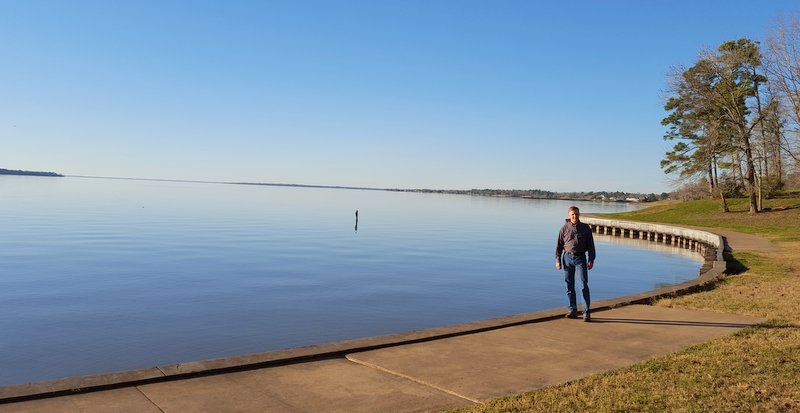
Lake Livingston is the second largest lake in the big state of Texas. It was a beautiful blue sky day, and the lake looked like a mirror on this calm day. Livingston was obviously showing us her best side on our tour.
In the middle of the week, we almost had the lake to ourselves. In the picture above, you can barely see Denisa--a pin point on the end of the grassy peninsula that jutted into the lake. You certainly can't tell it from this distance, but she has a big smile on her face. We did have to share the lake with a flock of ducks, that must be getting free hand-outs from the park guests based on the way they swam directly toward us.
Besides the modern infrastructure of the town, and the beauty of the loblolly pine forests and lakes, we also think Livingston is a very friendly town. This can be illustrated by the fact that we got not one, but two invitations to go dancing while we were in the area. We'll be leaving Texas soon, and we'll be missing the fact that Texans love to two-step. This picture was taken of some of our new dancing friends that invited us to a Sunday afternoon Mardi Gras dance at the Catholic church in Cleveland, Texas.
We love the new people that we are honored to meet every day in this lifestyle. We shared a table at the Mardi Gras dance with someone that you will probably recognize.
Yes, we were sitting at the same table with Uncle Sam! A head taller than anyone else in the group picture above (and almost twice as tall as Denisa), his long lean frame is a perfect fit for the Uncle Sam outfit that he had custom-made.
We are impressed with our new home town of Livingston, and the people that we met there!
When we started our full-time RVing adventure, one of the first tasks was finding a mail forwarding service. One of the most experienced companies in the country is run by the Escapees RV organization in Livingston, Texas. The headquarters of the organization, as well as the mail forwarding process is at their campground 6 miles south of town. Because RVers are always chasing rainbows, the name of the park is called "Rainbows End." So we spent five days camping here to learn more about Livingston and the Escapees organization.

We took a tour of the national headquarters, housed in the brick building pictured above. When it was built, they thought certainly they would never outgrow it. Four building additions later, they are still growing. It is here that they process mail for over 10,000 address holders like us. We went on the tour of the mail facility and got to see where we "live." We couldn't take any pictures during the tour, but their procedures and care of our mail made us even more satisfied customers. We call them when we need to know if a specific piece of mail has arrived, and they will check our file. When we need mail forwarded, we provide a general delivery address to the post office closest to us, and it arrives in 3-5 days. We usually get our mail delivered to us once each month. After using this mail service for over a year now, it was a little strange to actually be able to get our mail on a daily basis while we were here.
We were surprised at the number of houses at Rainbow's End. We assumed it would only be camping spaces, but many of the deeded lots also include stick-and-brick homes as well. Many of them included covered car ports big enough for an RV.
There is also an activity center complete with an outdoor pool, but the pool wasn't open during the winter.
There is also a club house for activities. We attended the line dance classes at the club house each morning. It was here that we met a fellow dancer that was gracious enough to invite us to two different local dances in the area.
One of the most unique parts of Rainbow's End is the Care Center. It provides care services for full-time RVers that have had surgery or debilitating medical conditions that need some assistance. It's like assisted living where the patient lives in his RV. They provide meals, laundry, cleaning, and transportation to doctor appointments; and it's at a price much lower than assisted living facilities because of the help from volunteers in the park.
There is also a clinic that is open two days per week. Knowing that it is hard for a full-time RVer to get an appointment to see a doctor, they are working to become a network of health professionals with clinics at all the other Escapee parks throughout the country.
Another service needed by full-time RVers is a good place to weigh our homes to be sure we are not over-loaded. We take motor homes that are meant to be used for occasional vacations, and we put everything we own in them. We have everything from snow ski clothing to snorkel gear with us, because we might need both in the course of our "vacation." So weighing each individual tire is important to make sure we aren't over-stressing our tires, axles, and frames in such a way to be unsafe on the road.

After the weighing we got a professional assessment of our results. We are glad to report that we were within all our weight limits, so we don't have to purge anything right now. One of the reasons we chose a diesel motor home is that it is built to safely carry more cargo. She did point out that the passenger side was heavier than the driver's side. I guess that means that Denisa needs to cut down on the calories, but she's going to blame the weight on the refrigerator and washer and dryer that are also on her side of the motor home.
We were out exploring the area while we were here, and did some extra cooking too. We still have citrus fruit left from our time in the Rio Grande Valley. So we found a recipe for grapefruit pie and shared the finished product with some of our neighbors.
One of our favorite parts of Rainbow End was our fellow campers. Many times we will be the only full-time RVers in a campground. But here we were just one of many. There were lots of other campers that understood our lifestyle, and a surprising number were close to our age. We all feel like we are happy with the pot of gold we have found at the Rainbow's End!