We have been complaining about the cold night temperatures for the last week. But today's picture looks like we have definitely traveled too far north. Our pictures are filled with white drifts taller than our car, and more of the white stuff covering the road.
It looks like a blizzard just went through this area in the mountains of New Mexico. There was large machinery removing loads of the white stuff to clear parking lots and roads.
We were surrounded by it for as far as we could see!
The main winter sport of this area is sledding. So we bought a sled, and headed to the top of the hill. It's a good thing Mark has been growing a beard to keep his face warm in these brutal winter conditions!
Denisa is obviously happy to be at the top of the sled hill as well.
Then she headed down that big hill, screaming all the way to the bottom!
Wait a minute! Why is Denisa sledding in her bare feet? and where is Mark's ski parka?
Well, we ARE in the mountains of New Mexico in January. But all this white stuff is NOT snow. We are visiting the White Sands National Monument, the largest gypsum sand dunes in the world.
Even though the mounds of white can look like snow, they are actually powder-fine sand.
Because the sand is made of very fine gypsum, it is perfectly white. This basin is ringed by mountains, and we enjoyed bright blue skies that made beautiful contrast to the white sand. We have definitely wandered into another of God's wonders today.
We took a hike through the never-ending dune fields. The ranger told us to be sure to follow the marked trail. We were on the Back Country trail, with orange trail markers.
Your instructions are to only continue on the trail if you can see the next marker. If you can't see the forward marker, you should go back the way you came reversing the markers.
It would be so easy to get disoriented and lost in this sea of white! We hiked in the sand on a loop trail that was several miles long, and it was so beautiful! Mark found that he is a tender-foot. Just like the sand on the beach will give him a blood blister when playing spike ball; going up and down sand dunes in the desert will do the same.
We took the time to watch the national park film at the visitor center, and we always learn things about the new environment we are getting ready to explore. We learned that the wind is usually relentless in this area, and the southwesterly winds constantly move the sand around in waves.
Those winds will cause the dunes to move 12-14 feet in a year's time. Areas where there is a shallow layer of sand will usually be covered by desert plants that enjoy this environment.
The blowing sand and higher levels of sand will have a grave effect on those cactus and grass plants that struggle to keep their heads above that shifting sand.
They will grow a stalk under the increasingly tall dune, trying to keep the plant on top of the shifting sand. This yucca plant is now completely hidden, with only the tall seed pods stretching out of the dune.
It made a neat picture with the sun and the sand and the struggling soapweed pods struggling for survival in this unusual environment.
When the dune shifts away from the elongated plant, there is nothing to support the tall stalk that formed under the sand. We saw lots of barren stalks across the desert valleys, that had collapsed.
Other plants have thicker roots, that form a mass under the sand dune. When the wind shifts the sand away from the plant, it cements the sand around it to form peculiar looking formations. Now in the open and flat areas between the dunes, this sand and root combination makes homes for some of the desert animals.
While watching the national park firm, we also learned about the desert animals. Most are nocturnal, thus avoiding the oppressive heat of this area in the summer. We didn't see any wildlife in our day-time visit. But we saw plenty of tracks in the sand verifying their activity.
The bird tracks were everywhere, but we also saw that some mammals run over these dunes.
Now that we have educated our readers about the flora and fauna of the White Sands National Park, we feel obligated to spend some time on the really important stuff. That would include one of Denisa's favorite new activities--sand sledding. We also took way too many pictures that she wanted to include in the blog.
We bought a used sled at the visitor's center, and used it to slide down the dunes over and over. Our favorite slope had a well-worn groove in the sand, that got smoother and faster as the sand packed down. We also bought wax at the gift shop. When applied to the bottom of the sled, it makes the trip down the hill faster as well.
Branching out and making your own trails can be adventurous, but not as fast until the sand gets packed.
Sometimes going down the slope involved rotating on the sled sideways.
And sometimes there is a fast dismount at the bottom.
Mark was quick to jump up after his sledding crash (but we can't say the same about the guy behind him in the picture below).
For some reason, the trips down the hill are faster than the trips back up. Every free-flying trip down the dune, means a laborious breath-sucking crawl back up the hill. But we try to think of all the calories we are burning with this exertion, and it makes us feel better about the ice cream we will eat later.
The slope of the dune is very important to the success of the sledding experience. If the dune is too flat, you sink into the sand instead of gliding over it.
The most important tip we can give on sledding is that this activity is more fun if you go with someone that also likes to have fun.
Used sand sleds and wax can be returned to the gift shop for a $3.50 rebate. We couldn't think of anywhere else we would use ours, or where we would store it in the motor home, so we took ours back and pocketed the refund.
White Sands was a great national monument, and we had a fun time visiting here. We spent most of the day hiking and sledding in the sand, and we were blessed with the perfect temperature for our visit. More importantly, we were blessed with an absolutely calm day. The winds that move these dunes around can sand-blast visitors on many days. As the sun fell low in the sky, our shadows grew longer.
We're glad to report that our shadows like each other almost as much as we like each other!
So our "white stuff" day in the New Mexico mountains was filled with bare feet and lots of sunshine and another of God's wonders.
After three nights in Van Horn, Texas, we were ready to head on west down I-10. We were blessed with another calm wind day--a rare commodity in west Texas. In fact, we remember that El Paso's weather forecast each evening included a wind-o-meter. So in our 3-hour drive we rolled through a calm El Paso and across the New Mexico state line.
Our destination is Las Cruces, where we had reservations at the Coachlight RV Park. Because of the cold temperatures and some blustery winds, we have left the motor home slides in for the last seven nights. We can live in these more cramped quarters, but we were looking forward to spreading out during this stop. So when we arrived in the early afternoon to find they had already rented out every camping site (even though we had reservations!), we were left with a "dry dock" spot in the back. Because it was a one-night stay until we move into our full hook-up site, we had night #8 with the slides in. Oh well!
We celebrated our change in plans by eating out and exploring our neighborhood. Just a few blocks away is the historic old town of Mesilla. The town's claim to fame is having the courthouse where Billy the Kid was sentenced to hang in 1881. Now the building is a tourist shop, but we can verify that they sell yummy cookies there. Mesilla feels a little like Mexico, with very narrow roads that lead to the little plaza. It's surrounded by gift shops, restaurants, and kiosks of craftsmen and bakers on a beautiful winter afternoon. We can recommend Andele! as a great place to eat. As the name would imply, the service was also fast.
The anchor of the plaza is the Basilica of San Albino. Built in 1907, it is now the center of the city, and even more important than the Billy the Kid courthouse.
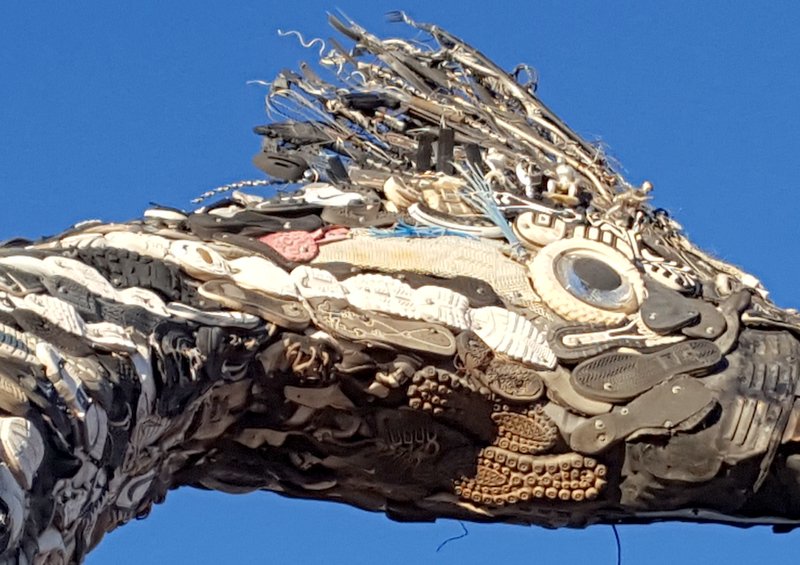
We left the narrow roads of Old Historic Mesilla, and headed a few miles down the wide lanes of I-10 to a unique rest area. Overlooking Las Cruces is a huge roadrunner statue. We're hoping that roadrunner isn't hungry, because Mark looks like the right size for a bird snack in the picture below.
It's hard to tell in the picture above, but this unique bird is completely constructed from recycled junk. This wing includes crutches, golf clubs, a computer keyboard, a cheese grater, a remote control, a wheel . . .
The white under-belly of the bird is actually the flattened tops of leather tennis shoes. Who knew that those shoes could resemble the texture of roadrunner feathers?
Shoe soles give the texture of neck feathers, and a headlight makes a nice road runner eye.
It's interesting to compare it to the roadrunner picture Denisa took less than a week ago.
Besides a giant bird, one of the main reasons to visit this rest area is for the birds-eye view it gives of the city of Las Cruces. We could look down the hill to see the town below, with the Organ Mountains rising in the distance. Those mountains rise to 9,000 feet from the desert floor, and make a dramatic backdrop for Las Cruces.
We have already noticed that much of the town is surrounded by orchards. We could see the neatly lined pecan trees in front of us. We also visited with the owner of an apple orchard, and we heard there are pistachio orchards in the area as well.
We like what we see before us, and we're looking forward to spending several days in the area around Las Cruces, New Mexico!
After a couple nights with temperatures in the 20's, we are feeling more confident in the kind of cold our motor home's plumbing can withstand. After seeing snowfall the evening before, we woke to a beautiful blue-sky day with no wind and forecast temperatures in the 50's. It looks like we will get to make that trip to the mountains after all!
We waited long enough for the sun to warm up the motor home a little, then made the one-hour trip straight north. It's a beautiful drive, as Van Horn is in the center of some really nice mountain ranges. There were a few low clouds scattered on our drive, with mountains sticking out over the top of the clouds.
Far in the distance, we could see a particularly beautiful mountain face looming ahead of us.
That would be El Capitan, the signature rock face of Guadalupe Mountains National Park. It was so tall that it peeked out above the clouds. An 18-wheeler coming down the highway gives some scale to the size of El Capitan.
This area is at a higher altitude than the town of Van Horn, and they still had a covering of snow on the ground. We took a picture of Mark Engelman beside an Engelmann cactus shivering in the snow.
Even though El Capitan has a handsome rocky face, the most famous peak is on the far right side of the picture below. That is Guadalupe Peak. At 8,749 feet, it's the highest point in Texas. We would have taken the 7-hour hike to the peak, but that would have us walking back to the car in the dark.
So after watching the film at the National Park visitor center, we headed toward the McKittrick Canyon trail. We started the hike bundled up with our warmest winter gear. Denisa is looking particularly padded this morning with insulated underwear, hoodie sweat shirt, coat, ear muffs and gloves.
We had several creek crossings, as the canyon walls grew taller. Then we spent the next thirty minutes of the hike removing layers of clothing as the weather got warmer and more beautiful.
At 1.5 miles into the hike, we came to the Pratt Cabin. We read that Mr. Pratt bought this land after it was described as "the most beautiful spot in Texas." We think the Pratts were like us--wandering His wonders in McKittrick Canyon. They had this cabin built in the 1930's, and the family used it until it was donated to the Guadalupe Mountains National Park.
It was a great place to be on such a nice weather day. After withstanding freezing temperatures, blustery winds, and snow, we really appreciated those blue skies!
The hike ends at "The Grotto," a white rock cave opening with stalagmites and stalactites decorating the entrance.
As evidence of the recent cold temperatures, there were still icicles fed by the water dripping down the walls of the cave entrance.
There were rock slab tables and benches at the entrance of the grotto--a peaceful place for a picnic lunch.
We loved our hike beneath the tall canyon walls of McKittrick Canyon. You can barely see Denisa in the bottom left corner of the picture, dwarfed by a mountain peak above. It felt like we were really in the mountains with the pine trees around us. We were blessed with such beautiful weather that we are liking the Van Horn area more and more.
The wildlife hid from us today. But we found some interesting flora. This is manzanita, whose bright red trunk accessorizes Denisa's sweatshirt nicely today.
Our last stop of the day at Guadalupe Mountains was the Frijole Ranch house. Built by a series of families that lived here in the mountains, it is now open as a museum. We met the volunteer that spends 4-5 days each week here cleaning and raking and scrubbing to make this a great stop for visitors. Because we might some day settle down and volunteer at state and/or national parks, we always enjoy hearing about their experiences. Gary is a great volunteer and a fun guy to visit with.
It's amazing that we had such great weather, and were blessed with perfect temperatures for a hike in Guadalupe Mountains. As we left the area, we have checked off another national park. We may be back, as being on the peak of Texas's highest point is still on our bucket list! But we might do that a little later in the year, when the cactus blooms unfold and there is less snow in the forecast!