Every morning, we've been adding "one more day" to our stay at the Coachlight RV park in Las Cruces. We have been happily surprised with things to do in this small city. We are especially happy with the hiking in the national monument area east of the city. So on our last day, we headed out to the Organ Mountains for a final hike.
These are the same mountains we had hiked a couple days ago on our Dripping Springs hike. But now we are on the backside, where the afternoon sun never hits. That means that the white stuff in the pictures today really is snow up at the higher elevations!
We've picked the Pine Tree Loop trail this day, and it is rated as "Strenuous." When the sign at the trailhead starts with "People have died while climbing in these mountains" you know it's going to be a great hike!
The best things about this hike is that you always have those snowy craggly mountain peaks in front of you as you climb up a relentlessly steep trail.
We are hiking among the scraggly desert trees as we got closer and closer to the base of the mountain.
As we continued to climb up, we were excited to see our first patch of snow. We had heard that Arizona had been hit with more cold weather and some unusual snow in early January. It looks like some of that is still lingering in the higher elevations.
The trail followed a little creek as we worked our way up the mountain and the water meandered down. We had our first-ever frozen water crossing as we continued higher.
Meanwhile, Mark is doing the rock scrambling that he is so good at. He is enjoying the sunshine of this beautiful day sitting on that boulder. We have really been blessed with perfect weather and no wind while we are visiting Las Cruces!
As we worked our way higher, there was more and more snow on the trail.
Because it has been trampled down by hikers, and has frozen over many cold nights, it is more like a skating rink. Because we are well up the face of the mountain with considerable drop-offs, ice skating is not our favorite sport right now.
Even with the snow, Mark has rolled up his sleeves as the temperatures rise to the 70's. Have we mentioned that we have been blessed with perfect weather this week?
We notice that the scraggly desert trees have suddenly turned into pine trees.
It's been a while since we have seen pine cones in the snow on a hiking trail!
We reach the half-way point of our loop trail at the highest elevation of this trail--6,880 feet. According to Denisa's Vivo Smart, we have climbed the equivalent of 88 flights of stairs. That's almost as many as the Empire State Building--but with better views! You can barely see Mark in his black shirt, perched on a boulder just a little right of center in the picture below.
As we head downward for the remainder of the loop, we are now looking at the sun-shine flooded valley rather than the snowy peaks.
About four miles away in that valley, we get a bird's eye view of the military base that is part of the White Sands Missile Range.
After we finished the 4.5-mile Pine Tree Loop, we drive towards that military base. White Sands Missile Range proudly proclaims it is "the birthplace of America's missile and space activity." They have an outdoor Missile Park that looks like toy rockets have been strewn about carelessly (until you see Mark standing at the base of one of those "toys.")
But actually, these are examples of the rockets, missiles, aircraft, and radars that have been developed and tested on this range since 1945.
We took a picture of the Patriot Missile, mostly because its name was the most familiar to us. This surface-to-air missile is the Army's most advance air defense system. They began testing the Patriot here at White Sands in 1970, with "innumerable" tests since then.
We should mention that the Missile Park is on an active military base, so we had to show our ID and get security clearance before we could enter the base. We're proud to say that we passed the background check with flying colors.
There were more missiles in the indoor museum, as well as historical information about the earliest people that lived in this area. Being a military museum, there is also information about the battles and military efforts that took place at White Sands.
One of the biggest projects of White Sands Missile Range was the V-2, so it got its own building.
We had a full day on this final tour of La Cruces. The sun was setting as drove closer to our campground on the other side of the city. We could see those beautiful Organ Mountains turning colors with the sunset. We had planned to stay three nights, and stretched it to five instead. That's what we love about our wandering life-style that allows us to stop and wander through special places longer.
We vaguely remembered that southern New Mexico is famous for its chile peppers. On our first evening in Las Cruces, we stumbled onto our first chile pepper field. In January, we were surprised to see so many of the peppers still on the plant, glistening red in the sun.
The bright red color of these peppers is a stark contrast to the clay-like New Mexico soil. Because they are usually picked in the fall, we're not sure why this field has not been harvested.

We realized that we knew nothing about these potent peppers, so we went in search of information. What better place is there to get educated than a college? So we headed to New Mexico State University in Las Cruces. Since we retired from a university, we like to visit campuses all over the country. We found the buildings on the NMSU campus to be a random mixture of architectural styles. But there were more flat-topped-clay-tiled-adobe buildings than most campuses.

After wandering around campus on a beautiful weather day, we finally got directions to the Chile Institute Store on the second floor of an academic building. Here we found a full-time employee that was happy to answer all the chile questions that had been burning in our minds. We found they have a master chile breeder at the university, who is responsible for most of the best varieties of chile peppers in New Mexico. At the store they sold seeds for those varieties, as well as salsa, cooking sauces, and these beautiful ornamental chile pepper plants that were developed on campus.
Their brochure taught us chile facts that we'll sprinkle throughout this blog. So when you see a random statement surrounded by asterisks, know that it is a chile fact from the New Mexico Chile Institute--not from us.
**One fresh medium-sized green chile pod has as much Vitamin C as six oranges.**
Our next source of education came from the Las Cruces Farmer's Market. At the Main Street Plaza on Saturday and Wednesday mornings, there was a chile vendor selling large and small bags of dried peppers and honey. They also had many of the ornamental ristras, made from attaching the dried peppers into decorative clusters. The shiny ones have been lacquered and are strictly ornamental. The duller ones can be used for cooking. By simply cutting off a few dried peppers, one can rehydrate them to make red enchilada sauce.
**One teaspoon of dried red chile powder has the daily requirement of Vitamin A.**
While we were at the farmer's market, we also learned that the official cookie of New Mexico is the biscochitos. Also called "wedding cookies" we tried samples of the pecan, plain, and raspberry chile biscochitos. But when it came to buy, Mark purchased a cherry/apricot empanada instead.
This chile-learning can work up an appetite. So Denisa purchased a half dozen mini-donuts from another vendor. We have heard about a baker's dozen, where you get 13 when you purchase 12. We got a baker's half-dozen because he gave us 7.
It looks like our stomachs made us digress a little from all things chile! Another vendor (selling jewelry) suggested going to Hatch, New Mexico, so we decided that would be another good source for our chile education. We had heard about Hatch chiles for years, and it is the self-proclaimed "Chile Capital of the World." We found ristras hung all over town, some almost as tall as Denisa.
**Hot chile peppers burn calories by triggering a thermodynamic burn in the body, which speeds up the metabolism.**
In a town 1,600, there are probably ten different chile stores in Hatch. This was our favorite, and had the best prices. We were amazed that bags of dried chile peppers were so cheap, and they were labeled from mild to XXHot.
There were big trailers full of more chile peppers outside. We liked this trailer with a door to get a close-up of its cargo.
There were more chile pepper trailers parked behind the store, with men working around a table separating them by hand.
**Teas and lozenges are made with chile peppers for the treatment of a sore throat.**
Because we don't have room in our motor home for a five-foot-tall ristra, we opted for the smallest bag of powdered chile instead. That smallest bag was actually in a one-quart zip-lock bag. We also found that this was dehydrated and powdered in a plant in Hatch, and is 100% chile. It is different from the chili powder available in the grocery store that has things like garlic, salt, cumin or oregano added to it. We also had to seal it in another bag, as its aroma is quite (ahem) robust.
**Capsaicinoids, the chemical that make chile peppers hot, are used in muscle patches for sore and aching muscles.**
In our quest for more knowledge, we felt compelled to do more tasting. So we visited the locals' favorite diner that says it has the "best burgers in town." Strictly for educational purposes, we ordered a green chile cheeseburger, and the chile relleno burrito smothered in green chile sauce. It was the most delicious educational experience we have every completed.
Our friend at the Chile Pepper Institute at New Mexico State University said his favorite chile dish was the green chile enchiladas at Andele's. So of course we had to try them as well. We should have taken a picture, because they were like no enchiladas we had every seen. Denisa ordered three chicken green chile enchiladas. What she got was actually three flat corn tortillas stacked one on top of the other, drenched in green chile sauce with grilled chicken piled across the top. Sorry that we didn't take a picture, but they were unique and delicious (and consumed before we thought about the camera).
**The color extracted from very red chile pepper pods, oleoresin, is used in everything from lipstick to processed meats.**
So we feel like we have learned much about the chile pepper since we've arrived in New Mexico. But being true scholars, we intend to continue in our quest for knowledge as we eat our way across the southwest in search of the best capsaicinoids now we know they are thermodynamic and naturally burn calories!
Ever since the first evening when we saw the mountains east of the city of Las Cruces, we wanted to get close to them. Mark took this picture that first night as the setting sun turned them pink and then purple.
When we drove past them on our way to White Sands, we looked longingly at those craggily peaks.
These are the Organ Mountains, that dramatically stretch to almost 9,000 feet in elevation, and well above the flat desert floor in front of them.
We found out that this area became a new national monument in 2014. Now designated as "Organ Mountains-Desert Peak National Monument," we headed to the visitor center with our national park pass for free entry. We got the ranger's best advice on a 7-mile loop trail, and headed out on an all-day hike.
As we hiked closer to the mountains, we could look back to see that this was actually several different mountains that ranged in color from deep red to almost white.
Our first destination was towards the darker mountains and the Dripping Springs area. The golden grass, coupled with the dark mountains and the blue sky made a glorious place to hike this morning.
Nestled up against the darker mountains, this has been a place of rest and solitude for many years. One investor built a resort here in the 1870's, and we came to the livery station where the horses and chicken coops were housed.
The Dripping Springs Resort was built into the side of the mountain, with awesome views all around. The buildings from the late 1800's were in disrepair, fitting in with their rocky surroundings as they crumble.
Hiking in January is too early for blooming wildflowers, but we found this hardy jasmine bush was putting forth dainty yellow blooms even now.
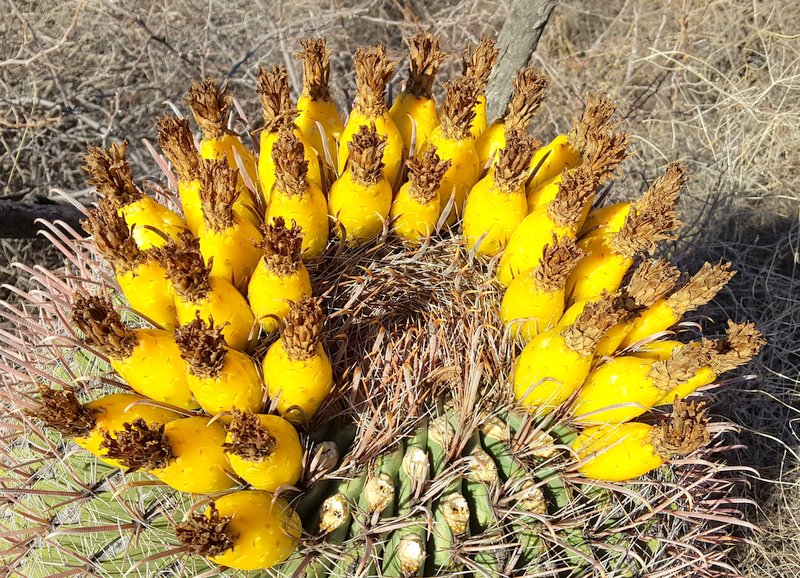
The only other blooms of the day were found on a giant barrel cactus near the trail.
These bright yellow pineapple-shaped blooms are hard to miss in the drab of the desert this time of year.
This property was purchased in 1910, by a wealthy doctor. When his wife contracted tuberculosis, it became a sanatorium for her and other patients struggling with the disease. The sanatorium is also crumbling, but we could see its roofs from above.
A less-traveled trail that wasn't on our map led behind the hospital. When we see these little trails, you can be sure that Mark will try them. It led higher up the mountain to a giant boulder.
Atop the boulder were views of the valley below, with the city of Las Cruces now barely visible far below. Even further down this little trail we found the Van Patten Reservoir. Built in 1892 to hold the precious moisture in this desert environment, it was an emerald green color today. We heard from another hiker that local children used to come here to swim. Today, it was closer to an ice rink, as Mark threw a rock to confirm that it was frozen this time of the year.
Water is important to survival in this rugged habitat. Our only wildlife sighting of the day was a lizard, staying close to this source of moisture. We watched as he scurried down the rock wall, to drink from the spring water.
Even though we saw ice around us, the temperatures were perfect for hiking. It was a 60-degree day with no wind and glorious blue skies!
This area is called "Dripping Springs," and we followed the water above the falls. Just because the water is flowing straight down, doesn't mean that crazy hikers would not follow it. So we started scrambling over the rocks, looking for the source of the springs. Denisa knows her scrambling limits, but Mark thrives on these tough climbs. He continued scrambling over boulders until he got to some glorious views of the mountains.
After this extra hike/climb, we considered heading back to the car. After all, Mark is nursing the blood blister on his foot from the sand yesterday, and the sprained ankle from three days ago. Anyone with good sense would call it a day with a good 3-mile hike. We never have been accused of having good sense, so we continued on the long loop hike we had planned this morning (when we were fresh). This took us in the foothills of the lighter-colored mountains.
Our next side trail would include a spur off to the Fillmore Waterfall. It's hard to say, "no" to a waterfall in the desert, so we made the extra one-mile trek. We were rewarded with a picture of the falls all to ourselves. The sparkling clear water flows through this canyon, so this was also a great picnic and rest stop.
Again, Mark couldn't resist the call to scramble over the rocks and through the desert thorns to get a view from the top of the falls. You can barely see him with his arms outstretched right above the water fall.
Just to prove that it is Mark, Denisa zoomed in on him from her comfortable perch at the bottom of the canyon.
Mark took a picture from the top of the falls, showing the rugged terrain that lowers into canyons and raises in majestic mountains. We finally left this oasis to head back into the desert. This seven-mile hike had gotten lengthened with extra trails and scrambling, and we were getting weary. But those beautiful blue skies are something that we never get tired of.
Now we headed away from the mountains, into the La Cueva area. This word is Spanish for "caves," and these large boulders housed at least one cave.
The huge rocks were thrown across the desert floor, and our trail snaked around them.
Inhabited by Native Americans many years ago, it was also home to a man named Agostini-Justiniani in 1869. Agostini renounced his priesthood and chose to live as a hermit in this mountainous area that is now called, "Hermit's Cave."
Close to a water source, and giving natural protection from the heat of summer and the cold of winter, it made a comfortable natural home.
From it's six-foot entrance, the views from the inside weren't bad either.
As the trail took us away from the cave entrance, we took another picture. It helps to understand just how big these giant boulders are when you see the cave. The six-foot entrance is barely noticeable as a tiny gap at the bottom of the largest rock in the center of the picture below.
According to Denisa's Garmin, our hike stretched to 8 miles by the time we returned to our car at the visitor center parking lot. It also included ups and down in elevation equivalent to 79 flights of steps. Since that device is on Denisa's wrist, we're sure Mark's extra scrambling gave him another mile and many more stairs.
Since we had seen a glimpse of sunset on these mountains from afar, we made the decision to stay a little longer to see it up close. We watched as the craggy peaks turned from natural . . .
to super-natural . . .
as the light from the setting sun turned them to a bright pink before our eyes.
The Organ Mountains are illuminated in a way that only God can do. Once again, we have wandered His wonders at one of the United States' newest national monuments. We have been blessed!