One of the main reasons we made this stop in Helena was its vicinity to another famous Lewis and Clark site--The Gates of the Mountains. We had been told several times that this was a not-to-be-missed trip. So in spite of the smoke, we made the 20 mile trip north of Helena to the boat dock.
Most tourists will see the Gates of the Mountains on a boat ride that starts at this marina. But we much prefer our own kayak when possible. We did our homework, and found that this trip is definitely doable on our own. So we launched the kayak into the perfectly still lake by the dock.
Then we kayaked next to the limestone walls as we turned out of the lake and into the canyon.
The Gates of the Mountains is a name given to this area by Lewis and Clark on their famous trek to discover a path to the Pacific Ocean. When the Corp of Discovery looked down the canyon with 1,200-foot-tall cliffs, it looked like they were gates that were closed over the river ahead.
But as they continued through the Missouri River Canyon, the "gates" opened. That's when Meriwether Lewis named this river gorge "The Gates of the Mountains." That name has stuck for the last 200 years.
It was nice to see a bit of blue sky above the limestone cliffs. We got blue sky times two, with it also mirrored in the river as well.
We found that it was hard to take a picture that captures the size and grandeur of these 1,200 foot tall cliffs. We saw one other group of kayaks on the Missouri River today, and they give a little bit of the scale of size. You can barely see the red and yellow kayaks in the water in the bottom right hand corner.
On July 1, 1805, Lewis recorded this description in his journal: "This evening we entered much of the most remarkable clifts that we have yet seen. These clifts rise above the waters edge on either side perpendicularly to the height of 1200 feet." In their long voyage up the Missouri River, these cliffs were their introduction to the rugged Rocky Mountains ahead.
These cliffs run for 6 miles, and of course we had to kayak to the end. We were glad to take a break at the picnic grounds about half-way into our journey.
Just past that point is Mann Gulch. In 1949, lightning started a wildfire that entrapped 13 men that were part of a smokejumper crew in this steep canyon.
We paddled the six miles to the end of the canyon, and were ready to turn around. That's when a fisherman urged us to paddle a little further. Just around the next curve is a natural mineral lick where big horn sheep often come to the water's edge.
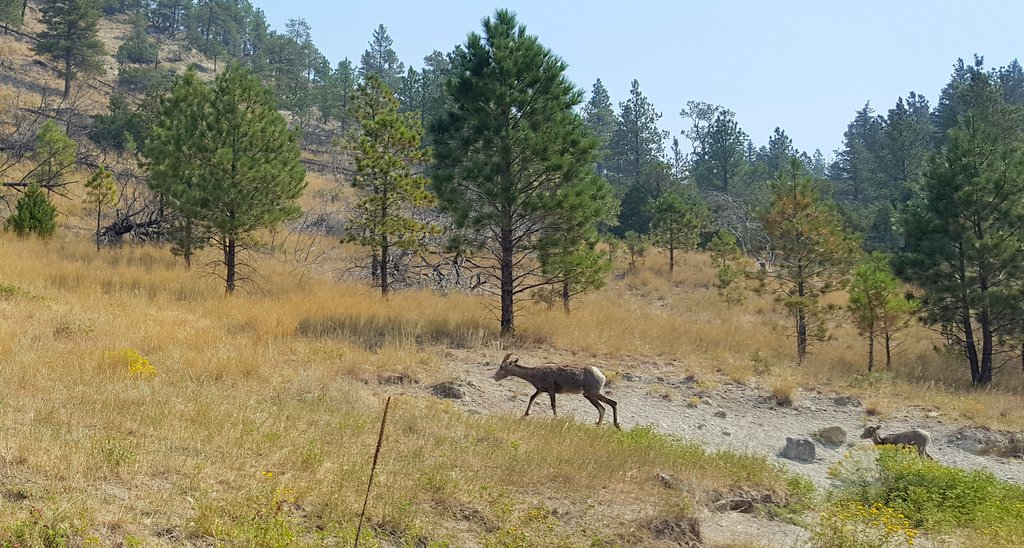
Sure enough, our extra effort was rewarded with some close-up views of a small herd of sheep. These ladies are not as regal as the males with their large curving horns.
But they have with them the long-legged babies that are cute in their own lanky way.
With our silent kayak, we didn't seem to bother the herd. This mother came down to the water not far from our boat. The banks are steep, and getting a drink is a precarious exercise.
We wouldn't have gotten that close-up look at the herd if we would have been riding in that noisy tour boat. We could hear them a mile away as the engine noise echoed off the canyon walls.
We watched as the tour boat left us behind. We recognized one advantages to riding on that boat, when we knew that we had to paddle six more miles to get back to the dock. The good news is this stretch of the Missouri River has a dam on both sides of the Gates of the Mountains. So this six miles is almost without current to row against. Of course, the afternoon winds have picked up a little, giving us some resistance on our trek back.
We had some entertainment from more wildlife along the banks. There was this mule deer with ears perked in two different directions as she checked out the kayakers in the water.
We assume these mule deer have incredible hearing, with ears that look out of proportion to their dainty heads.
There were also a few birds on our voyage, including this sizable white pelican reflected in the water.
We have to admit that our arms were really tired by the time we rowed the 12 miles today. As pretty as those tall limestone cliffs were, we were both glad to shut the door on the Gates of the Mountains. The mirror-like lake beside the dock was a welcome sight.
We have done some Lewis and Clark hikes, but this was the first time we rowed where these famous explorers rowed. Besides some sore shoulders and some smoky views, it was a great day on the Missouri River at the Gates of the Mountains.
The next two days we saw air quality worsen as winds brought in more smoke from the wildfires in Montana. We did make a trip to downtown Helena on Sunday morning for church. We enjoyed the services at Narrate Church, held in the Grandstreet Theatre. This building was built as a church, then re-purposed as a theatre. It has come full circle now that it has church services on Sunday mornings once again.
Aside from that trip to church and a shopping trip for food supplies, we spent an unusual amount of time inside the motor home, staying out of the smoke. When shopping for a motor home, we looked for one that would be comfortable on those rainy days when we couldn't spend time outside. We didn't realize that there would be smoky days that kept us inside as well. It's all part of the adventure, but we're ready to move out of the smoke!
We have really liked our time in Montana, but it feels like we have been running from the smoke for the last month. We found blue skies in the north, but we know there are more wildfires raging as we head south. Driving the motor home along this narrow highway, we can see the Rockies on the right side of the picture. But they are completely obscured by smoke on the left. We know there are mountains there, but we can't see them through the smoke.
As we headed south, the flat plains turned into rolling hills with a sprinkling of pine trees. Then we headed over a pass and found ourselves in the middle of a rocky, thickly-forested mountain range.
This 1.5 hour drive south has brought us to Montana's capitol city--Helena. With a population of only 31,169 people, it's one of the smallest capitol cities we have visited. But we like that, because it means traffic is minimal and parking is easy. We drove right up to a free parking place in front of the state capitol.
Denisa especially liked the floral display in front of the capitol building. It said, "Montana 2017" in orange and silver flowers. The gray and smoky skies behind the capitol told a less beautiful story about what was going on in Montana during the summer of 2017.
While admiring the blooms, we found a beautiful winged visitor.
We could see that this guy was enjoying sipping the sweet nectar from these bright blooms.
Montana has spent a lot of money to get their capitol looking its best. Like many state capitols we have enjoyed, this one has a beautiful dome in the center. There were four pictures encircling the dome, representing the four groups that have had the largest historical effect on this state--cowboys, trappers, miners, and indians.
Floors have been re-tiled, and walls have been painted in their historical style. The red and green color combinations looked classy, and the stained glass windows and grand staircase were beautiful.
We have discovered that we enjoy a guided tour, and learn so much more about a state from a local guide. But because of budget shortfalls caused from the expense of fighting forest fires, guided tours were discontinued just two weeks ago. The governor has announced a ten percent decrease in all state budgets. So we used the self-guided pamphlet to find our way around. That's how we found the Charles M. Russell picture hanging at the front of the House of Representatives. We've heard a lot about this famous Montana artist, and we are a little disappointed that the locked doors and no guided tours kept us from seeing it up close.

We learned that the town of Helena got its start in the 1860's when four guys from Georgia determined this was their last chance to find gold. If they didn't find it here, they would be forced to head back east as failures. But they did strike it rich here with a gold vein in the gulch that runs through present-day Helena. One of the main streets here is "Last Chance Gulch," and part of this thoroughfare has been turned into a pedestrian plaza. On a summer evening, we saw it filled with locals meandering among the restaurants and shops. The most popular business seemed to be the Big Dipper ice cream store.

It was also interesting to see a touch of history in the naming of one of the local elementary schools. The "Four Georgians Elementary School" would have puzzled us if we hadn't already read the story of the four easterners that hit it rich here. This is a great little city filled with lots of green spaces. We spent some time walking those public areas and found this bronze grizzly bear hanging out at the pond. Since meeting a couple bears on a recent hike, Mark felt comfortable to sit down with this guy.
A children's museum had music-makers outside, and Denisa was trying hard to make a song with the ill-tuned pipes.
There are flowers in some of those parks, and these Gaillarida were especially lovely.
With drought conditions and fires plaguing the state, this honey bee was happy to see some bright blooms. So was Denisa.
One of the downtown walking areas is the historical Reeder's Alley. Saved from demolition by the local historical society, it looks much like it did 100 years ago. It's another public walking area that is fun to see on a cool evening. In another part of town, we see the city's history reflected in streets lined with hundred-year-old mansions. At one time, Helena had the biggest percentage of millionaires per capita of any town in America.
The city of Helena has "selfie spots" all over town. The idea is for people to stand in the foot steps and take a selfie to post on social media to publicize the city.
We're not a fan of selfies, but behind us you can see another green pedestrian area of Helena--Northern Town Center. You can also see the gray skies of this smoky city.
We drove by another of Helena's icons, the beautiful Cathedral of St. Helena. Those twin spires are the city's most recognizable landmark, but they were obscured by the smoke much of time while we were visiting.
When we are visiting a new city, we love to find fun places that the locals enjoy. We found the Great Northern Carousel, and Denisa always loves a good merry-go-round ride. This one features 37 hand-carved Montana animals. Denisa had to choose between many of the wildlife we have enjoyed--bear, big horn sheep, prong horn antelope, etc. She chose a mountain goat because it was on the outside, and she was excited to find another carousel with rings to grab on each revolution. Alas, the little girl behind her got the brass ring. She really wants to get a brass ring, but she has mixed emotions about taking that honor from one of the children on the ride.
We had other things planned for our stay in Helena. We normally would have hiked to the top of Mount Helena, and walked the Upper West Side area where the most mansions stand. This is the kind of small city that we like, where it doesn't seem unusual for a deer to meet you running down a street.

But with hot temperatures and poor air quality, we spent most of the last two days indoors. Montana is experiencing near record high temperatures, and we had highs in the 90s during our four-day stay. We also saw our first air quality that had "Unhealthy" warnings for the area during our last two days in Helena. This town is used to smoky summers, but this is one of the worst. The local news showed a graphic that compared the number of Montana wild fires and acres burned over the last twenty years. Aside from the record-breaking year of 2012, this is the worst fire season that Montana has seen in those twenty years. We love experiencing unusual fun events, but we are sad to be here while Montana is experiencing unusual fire events.
We saw a return to blue skies here in Choteau, Montana, so we took that opportunity to head straight west into the mountains. This area is called, "The Front" because it is the eastern (or front) side of the Rocky Mountains. It is amazing to see the mountains rise straight up out of the flat plains. This is our view from our campground, as we look west to the silhouette of the Rocky Mountains.
It was a 30-mile trip over some bumpy gravel roads to get to the trail head. The drive took over an hour, and we saw only three cars during the entire trip. Then we reached "The Front." Welcome back to the Rockies!
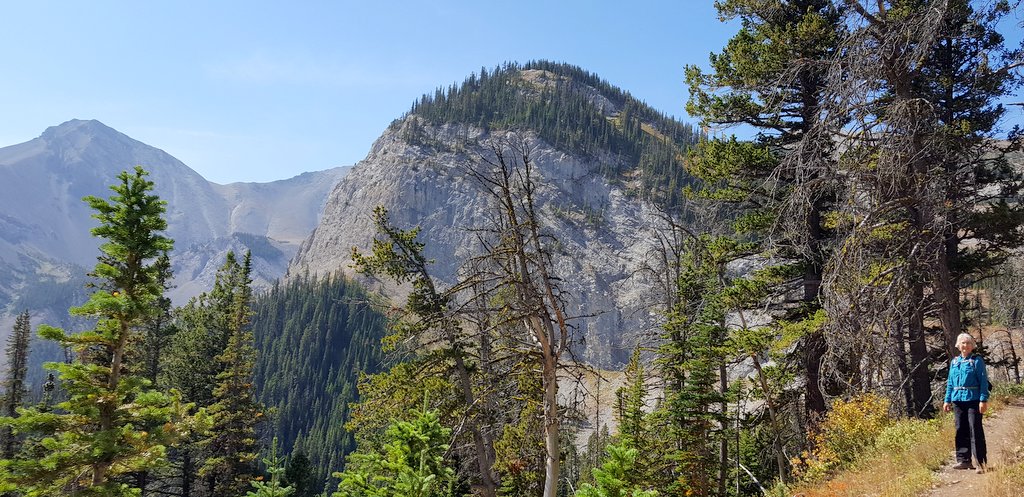
We headed up the trail to "Our Lake." After all the crowds at Glacier National Park, it was almost shocking to arrive in the middle of the morning and still have plenty of parking. It's nice to be in a lesser-known part of the Rockies! The trail ascended through the forest, always heading upward. We finally came out of the forest and into an opening to see that the mountain tops were now within our grasp.
As we walked across the side of the mountain, we couldn't help but notice the brilliant blue sky. It looks like The Front is getting a break from the smoke today.
We love hikes that take us to the top of mountains. We especially like hikes that lead us to beautiful mountain lakes. We found both of those today.
Another perfectly clear lake, we could see the rocks below the cool blue water of Our Lake.
We also love hikes that have some wildlife. We could hear the whistles of pika running through the rocks around the lake. Denisa was determined to get a picture of one of these little guys.
The locals at the lake said the name is pronounced like "Pike-uh." It is a relative of a mouse, but a whole lot cuter. They remind us of wild hamsters.
We have also heard pika pronounced "peek-uh." Denisa caught a picture of this little guy nibbling on seeds and leaves. For those that are familiar with the pokemon characters, this could be a picture of a pikachu.
We thought that might be the only wildlife at the lake. Then we heard the bleat of a young goat, and looked skyward.
Standing at the top of the mountain was a herd of mountain goats looking down on us.
We wouldn't have spotted them at the top of the mountain without the young goat's call and the falling rocks as they made their way down towards the lake.
More appeared from the mountain summit, and we watched as a sizable herd showed off their rock-climbing skills.
Even this late in the summer season, there was a patch of snow on the mountain. While some goats seemed to prefer the rocks, others took the route across the snow.
Unlike the crowds at Glacier National Park, there were only three other hikers at the lake. We all watched as the herd headed down towards the water and Denisa got this picture of the leader of the pack. We also found that this rock climbing must be hard on knees. Most of the goats had the hair completely worn off their knees.
We had a beautiful spot at the lake for our picnic lunch. We had views of the mountains and the clear water of the lake. Have we also mentioned how much we appreciate the blue-colored skies?
We are also amazed that wildflowers are still blooming this late. We especially thought these unusual blue blooms were nice.
We decided to walk around the lake for views of the other side. That's when we saw that the goats had finally made it to the water. As we got closer, we got some better pictures from a new perspective.
It was interesting to see that some of the goats were slick and white, while others were stubbornly hanging on to last winter's thick and now dirty coats.
It seemed to us that it was about time to start a new winter coat, as it can start snowing in this area in September. After the group of mountain sheep left the shore, we saw that they were losing some of those stubborn clumps of winter wool.
After spending an hour at the lake, it was time to head back down to the car. But we took one last picture at the top with a view of the mountain-tops around us.
As we hiked back down the trail, we noticed that some of the plants along the way are changing into their fall colors.
We also saw evidence of the prolonged drought in this area. The plants are really struggling, and it looks like the smoke in the air is moving them into autumn ahead of the normal schedule.
We continued hiking down the mountain, when the oddest thing happened to us. A squirrel came running down the trail at break-neck speed right toward us. In fact, he almost ran between Mark's legs, and we were a little worried that he must be rabid to come at us with such terror in his eyes. He made a terrified circle around us, then headed into the tall grass of the forest. What a strange thing! But then we saw the reason for his terror--a weasel was running after him.
For a moment the weasel lost sight of the squirrel. He circled up on a dead log momentarily, and Mark pointed the camera and luckily caught his picture. Doing some research, we found this to be a weasel--one of the most cold-blooded hunters of the forest. He ran down the trail, zipped back on the log, and we worried he was headed up our pant legs. Mark pointed the camera again, and got this blur as the black-tailed weasel flew across the trail one more time.
Then he darted into the same tall grass that was hiding the squirrel. It was the oddest thing to listen to the painful squeals that came out of the tall grass. Watching the jerky movements of the grass, we knew there was a desperate fight for life. We couldn't see anything, but finally the squeals stopped and we assumed that the weasel had done what they love to do--hunt down a sizable rodent.
In all the miles we have hiked, we have never witnessed anything like that. It was a long walk back to the car, but the good news is that it was downhill all the way. There were no more goats, no more pikas, and no more life-and-death battles as animals ran around our legs. We really liked our hike to Our Lake! It was a beautiful place on The Front to spend an afternoon, and we logged another 9 miles of hiking.
From the hill above our campground at Choteau Mountain View Campground we could see the Montana sky painting a pink sunset. We'll be leaving here tomorrow, on our way south through this state.