Friday, September 11, 2020

Mesa Verde National Park.

After six nights at one of the best Forest Service campgrounds in the country, it was time to move. Even though it was only a one-hour drive, it was all downhill. We went over Lizard Head pass at 10,222 feet in elevation, and landed in Dolores, Colorado at less than 7,000 feet. We exchanged our mountains and tall pines for desert sand and sage brush. To get there, we crossed the Dolores River. We had hoped to kayak here, but the continuing drought in Colorado has turned parts of the river into a rock garden. So we turned our minds from cool water activities to hot hiking activities.

We are staying at Circle C RV Park, another Passport America park that honors the half-price rate during the week. The main reason we are here is that it is just 16 miles from a national park we have never visited--Mesa Verde. It's home to some of the best preserved pueblo dwellings in the United States.

We soon found that even after arriving at the entry point of Mesa Verde National Park, we still had a lot of driving to do. It was a 45 minute drive up winding roads to get to some of the first stops inside the park at the "Far View Sites."

These were actually some of the most fun sites of the day because we could actually walk into rooms and look down into the kivas where people lived and walked 800 years ago.

At other locations, a chain fence kept us on the edge. But we were still able to peek inside what life might have been for the ancestral pueblo people that built rock homes here on the top of this green mesa at Mesa Verde National Park.

This group of native Americans was settling down from a nomadic existence, and began raising crops and living in permanent structures. In their busy schedule of making everything they needed to survive, at least one resident had time to do a little ornamental carving on this residence.

After our drive up the mesa, we headed down Chapin Mesa Road to get a view of the canyon. It was here that the ancients found out that the alcoves at the top of these canyons provided a roof and part of the walls needed to build a shelter. During the 1200s they left their homes built on top of the mesa, and started building in the canyon walls.

If we zoom in on those canyon walls, we can see the stacked stones that were neatly fitted under the rock ledges. Most of the structures we will see today have been fortified and preserved, but they are in remarkable shape considering that they were built 800 years ago, and then mysteriously abandoned 100 years later.

Over and over, we saw the ruins left behind by families that lived in this canyon in the 1200's. 

The most famous of all the cliff dwellings in this canyon is the Cliff Palace. But the observation platform is the closest we can get to the palace this summer.

Normally, visitors to the park can reserve a ranger-led tour that would take them on a hike across the canyon and right into this village that includes more than 150 rooms. But Covid has changed the national park experience at many of the best parks in our country.

Likewise, on the other-facing wall of the canyon we can barely see the Balcony House tucked under that arched opening at the top of the wall.

A reservation ticket can usually be purchased to tour the Balcony House. That tour includes climbing the 32-foot ladder that takes visitors into the house to walk where the ancients walked. These tours put you right into the ruins, and they are guided by an expert that can explain everything you would be seeing. We're sorry that we are missing that opportunity this summer.

We continued our drive around the Mesa Top Loop, stopping at each of the view points, and taking the obligatory pictures.

Most of the pictures were taken with a zoom lens across a canyon opening. It was a little like hunting Easter eggs to find the rubble that was hiding in the nooks and crannies of the canyon walls. Within this large national park, there are 4,500 archaeological sites. It seemed like we saw a lot, but we obviously saw just the tip of the iceberg here.

We were tired after our tour of everything that was open this summer. Because of the Covid changes, much of the park is closed. That includes the visitor center, the archaeological museum, and the entire half of the park located down Wetherill Mesa Road. More importantly, the guided tours into the four best ruins have been cancelled since spring. 

We obviously could return and have another full day of touring to all the sites that were closed to us today. We'll have to do that some cool spring or fall day. But on this summer day we saw all that our temperature gauges wanted to see.

So we headed back to our campground at Circle C, for a delightful sunset in the desert. We can tell that some of the smoke from the forest fires in Northern Colorado have slipped down south, as that red sun sunk into the sage brush. It has been another great day of wandering God's wonders even when parts of it were closed this summer.

Wednesday, September 9, 2020

It's a great hike that starts with a Bear!

 It's our last day to enjoy the great hiking in the mountains around Telluride, and we're taking the advice of fellow campers that really enjoyed the Wilson Meadow Trail. So we're up early, and on the trail covered with wildflowers above Trout Lake. But this hike would have a very unusual start this morning!

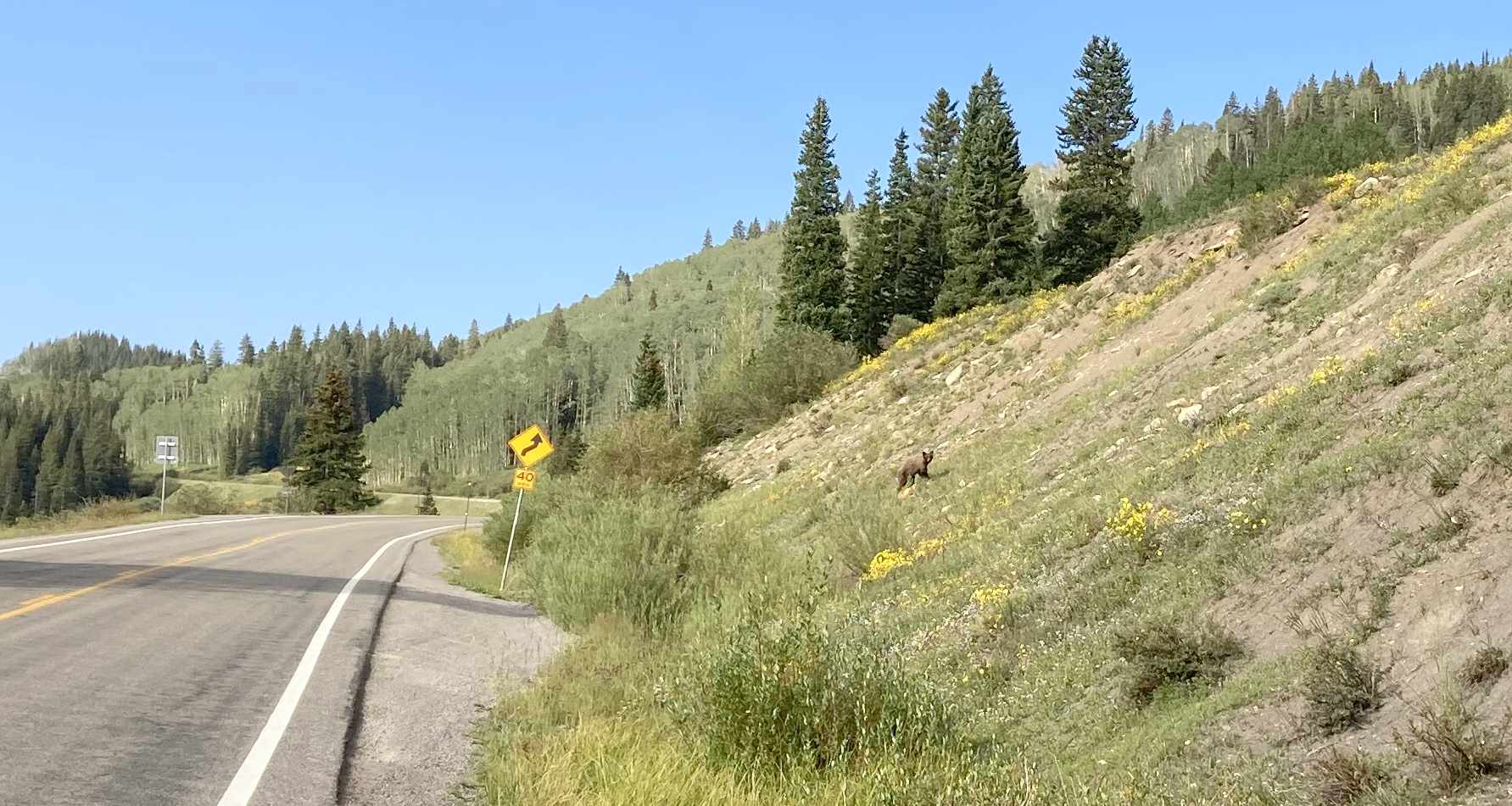
As we look down the highway, we see a brown silhouette coming from the direction of the lake, heading up the hill after crossing the road.

Mark whips out his phone to take a picture as the brown silhouette stops on the side of the hill.

At first we thought it was a young bear, and we were looking around for Mama bear to follow. But when we got this better look, we saw it was an adult bear on our trail first thing this morning.

Our bear was heading up-hill, and so are we. He headed into the forest beside us, and we assumed that was the last of our bear sightings for the day.

But as our trail took us closer to the trees, we saw movement in the shadows.

At times we could see the bear's back as it ambled through the brush. The long shaggy hair on its back was strikingly lighter than the dark head of this black bear.

Now that we know there is no Mama and baby bears, we aren't frightened at all. Black bears are usually docile, so it was fun to continue up the mountain beside the bear. It would often stop to dig and eat, and it wasn't concerned about us at all.

Only a few times could we see its face, as he acknowledged our presence.

Then it showed us its shaggy back again as it ambled deeper into the forest in search of more things to eat.

That bear sighting certainly made the first mile of the Wilson Meadow trail more exciting than we expected. Now it's time to get down to business and get some really steep hiking under our belts.

We are used to hiking up to lakes, and up to summits. But today we are hiking UP over the ridge . . .

so we can hike DOWN to the meadow. But once we topped that ridge, we were able to see Lizard Head Mountain in front of us at all times. If you see the mountain in both pictures above and below, you can't miss the knob on the top called Lizard head.

It took one more push up a wildflower section of the trail,

before we found ourselves in Wilson Meadow. We have wandered into another of God's wonders!

We kept taking pictures up close,

and pictures very far away trying to capture the size and majesty of this big meadow. Our campground friends that recommended this hike have done trails all over the world. She exclaimed that she had never seen such a beautiful place as Wilson Meadow!

Since this is our last mountain hike for a while, we stretched our hike by adding another mile by walking around the perimeter of part of the meadow.

Denisa spent her time sitting in the grass, taking pictures of tiny wildflowers that she had never seen before.


Then she found herself in the middle of a sea of these feathery purple blooms,

and found a hummingbird moth that was enjoying them even more.

All this hiking and picture-taking was being overseen by the watchful eyes of the lizard, on the top of lizard head mountain.

After taking way too many pictures in the meadow, it is time to head back up . . .

and then back down our trail towards the car we left close to Trout Lake.

We're still seeing beautiful specimens of flowers in spectacular shades of blue!

We finished up this 7.2-mile hike (with 1,709 feet elevation gain) as we neared Trout Lake where we started this morning. We kept looking for the black bear we left in the forest earlier, and we were a little disappointed that we didn't get to see him again on our return trip.

This lake and the end of this hike are just two miles away from the Matterhorn campground where we have been blessed to live for the past week. It's been a great time in these mountains near Telluride, Colorado, and we'll be sad to leave them in the morning! We would say that this last hike to Wilson Meadows was good, but it's a great hike when it starts with a bear!

Monday, September 7, 2020

We are becoming lake snobs

When you spend the summer in some of the most beautiful landscapes in the world, you will eventually get to the point where you are over-wowed. We have hiked some of the best hikes of our lives in the last couple months, and been face-to-face with some of the most beautiful mountains. We have also found that we are becoming lake snobs. Even when we plan to go kayaking, we often get to the lake and decide it's too round, or the water is too low, or it's too windy, or it's too close to a busy highway. But right now we are living among some of the prettiest scenery of the summer, and that includes the lake just two miles away from our front door.

We have driven by Trout Lake several times, and we snapped this picture one evening from the highway.

We've also driven around the lake during the day, and found that there are some great no-hook-up free camp sites behind it. A train track must have ran behind this little lake at one time, as we also found its old trestle.

We have probably become lake snobs because it does take about 15 minutes and some trouble to get the kayak out, inflate it, and get it on the water. Then we know that at the end of the paddle time, we have to dry, deflate, and fold everything neatly away for next time. That's another 20-30 minutes. So we don't go kayaking unless we feel sure that it will be worth that much trouble. But these two snobs had decided that this lake was worth it, and it was the prettiest when it is lit up by the setting sun. We intentionally got there about an hour before sunset to do some paddling before the light magic happened.

The birds kept us entertained while we waited. This osprey made several unsuccessful plunges into the water, before coming out with a sizable fish.

We also got a close-up of a couple Canadian Geese when they came in for a landing on Trout Lake.

This is a pretty picture of them in the water, topped with one of the mountains that surround the lake.

The wind was blowing a little when we first got on the water, but now it has calmed so the water is a mirror to the mountains.

As the setting sun lit up the circle of mountains, we took a picture of that glass-like water reflecting them. Denisa kept the nose of the boat in the picture just to prove that we were really there, and this wasn't just a too-perfect painting.

As lake snobs, we can tell you that our favorite lakes have mountain views, protection from the wind, and a road that allows us to get close so that we don't have to carry the kayak too far. It's nice that this one even has a boat ramp, and is just a two-minute drive from our doorstep. 

As we beached the kayak on the boat ramp, we have to say that we've been blessed to wander via kayak on another of God's wonders. A couple of lake snobs really enjoyed their evening on Trout Lake!