After arbitrarily deciding to camp in the little town of Navasota, Texas, we discovered a state historic site just six miles away. We decided to head that way just to see what a park called "Washington on the Brazos" might mean to Texas history. Now that we are Texas residents, it is time for us to learn more history about this big state. We knew that it had a long and colorful past, because we knew about "Six Flags Over Texas." That's more than just a theme park with roller coasters, and the town of Navasota has a park where all six flags are flying.

Starting from the right hand side, it was first a property of Spain (flag #1) and France (flag #2), and then Mexico (flag #3). Then the leader of Mexico went rogue and declared himself a dictator. This guy's name was Santa Anna--not to be confused with the good guy known as Santa Claus. A bunch of Texans didn't like Santa Anna's new rules, and decided to do something about it. That's when skirmishes like the Dawson massacre and the black bean death lottery happened, and we just learned about that last week at a Texas state park called Monument Hill. There was also a little skirmish that we all remember at a place called "The Alamo." 167 miles away, the little town of Washington sitting right on the Brazos River (hence the name of the park) comes into play. A plain wooden meeting hall in that town now claims the title of "the birthplace of Texas".

While all the feuding was going on in San Antonio, Sam Houston got together a group of men to write and vote on a brand new constitution that would make Texas a country of its own. Seventeen days later, it was signed by the delegates in a room that looked like the one we are sitting in, pictured below. Suddenly there was a fourth flag--and Texas was a Republic in 1836.
(Here's a totally unrelated but interesting side note: Denisa thought the volunteer leading our tour here looked familiar. After talking with him, we realized we met him and his wife while they were volunteering at a national monument in the San Juan Islands of Washington last summer!)
We were surprised to see a map in the visitor center that showed this new country of Texas extended up through parts of Kansas, Oklahoma, Colorado, New Mexico, and even into Wyoming. We had never known that the Oklahoma panhandle (where we were raised) was once part of the Republic of Texas. This flag flew for ten years, first led by Sam Houston. The last president of Texas was a doctor by the named of Dr. Anson Jones. The second part of our day took us to visit his farm, which is also part of the Washington on the Brazos state historical park. Dr. Jones's "dog trot" house, built in 1844, has an opening in the middle that allowed for an open-air living area in the shade during the hot Texas summer months.
The backyard had a couple smaller buildings--the kitchen on the left and smoke house on the right. The idea of cooking inside the house was not only smelly, but dangerous with an open fire used for most meals. Notice that Mark is hanging out at the kitchen like he usually does.
There were also barns and slave quarters across the field. This living history farm is named Barrington Farm, after Dr. Jones's boyhood home in Massachusetts.
Our animal pictures of the day have to include the farm animals kept here at the barnyard. The Tom turkey is obviously trying to impress the hen beside him.
This is a living history farm, and they try to keep it as true to the animals and practices of the 1840's as possible. This is the same breed of pig that the Spaniards brought to this area. The sow gave birth to eight piglets two weeks ago, and we could see that she needed a little time to herself. She crawled into the trough, and when one piglet climbed up next to her, she flung it off with her snout.
The farmer/ranger told us that many of the piglets don't look like any of the farm pigs. That's because the father is a feral hog that manhandled his way into the pen uninvited.
Our favorite farm animal had to be Slim. We called him a Texas Longhorn, but the ranger corrected us. Slim is an oxen. He also showed us the wooden yoke that Slim and his partner wear in order to help with some of the heavy pulling here on the farm.
Like many of us, Slim thinks that the grass looks greener on the other side of the fence. We were a little concerned how he would get those long horns back through the fence, but he didn't seem to have much trouble. We think he has done this trick before.
The ranger also gave us lessons on cutting the grass around the farm. The most important thing is a sharp scythe, so he spent some time sharpening the blade before he started. Instead of the normal ranger-clothes, he is wearing clothing reminiscent of the 1840's at Barington Farm.
Then we got some tips on proper scything skills. This experience made us glad that now we have lawn mowers. We're even more glad that we don't have any grass to mow!
They won't be mowing this section of the state historical park for a while. We found big fields of bluebonnets and other Texas wildflowers!
While Dr. Jones was still president of the Republic of Texas, he was also communicating with the country to the north. After ten years as its own country, Texas became the 28th state in 1846. That brought about the 5th flag--the United States Flag. The 6th flag came in 1861, when the confederate flag flew over Texas for four years. We've finished our Texas history lesson and its tale of six flags. We hadn't even heard of a state historical park called Washington on the Brazos before today. But armed with our Texas state park pass, we had a free and interesting day learning where Texas was born! This is another gem we found just wandering around this great country of ours.
The trip from La Grange, Texas, to our next destination took longer than usual, because we made an interesting pit stop along the way. We were driving through Brenham, Texas, and we just had to stop to see the home of Blue Belle Ice Cream. We saw evidence that this town has benefited greatly from the generosity of this ice cream company. We parked our motor home in the parking lot of the Blue Belle high school football stadium . . .
and we walked beside the Blue Belle Aquatic Center.
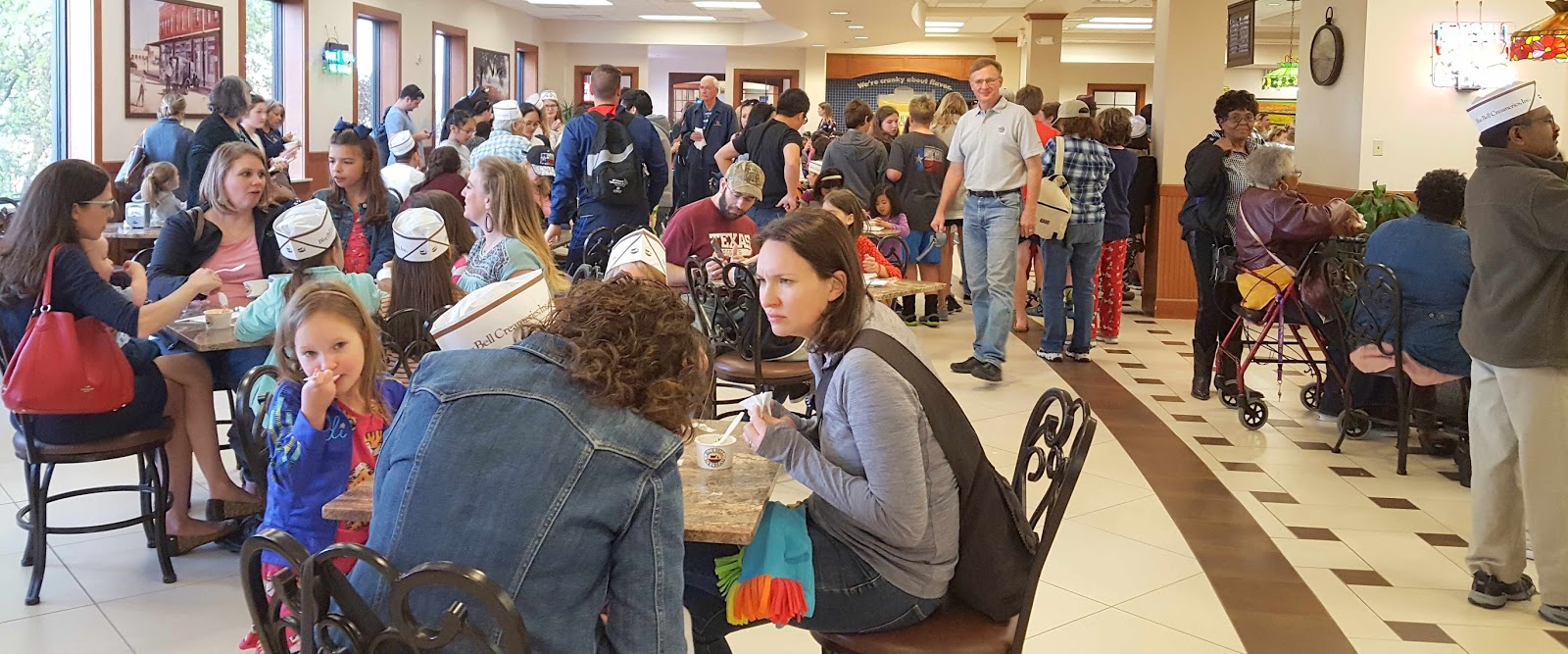
We had this little walk because the parking lots at the ice cream factory were far too busy and full to fit in another car--much less a 35-foot motor home pulling a car. It seems that we have once again managed to visit a very popular kid destination during spring break. (This brought back memories of last year's spring break visit to the Jelly Belly factory in California.) There were families every where, and the line for ice cream was long!
We took in the informational items at the visitor center. We learned about the 100-year history of the Blue Belle Company, and the process for making ice cream. But none of the displays were as photogenic as the picture booths they had set up for the spring break crowds.
Denisa is thinking about coming out of retirement to be a taste-tester here!
Next, we headed over to the ice cream parlor next door. Generous scoops cost only $1, and we taste-tested the pistachio almond and strawberry cheesecake. No pictures were allowed, but we also got to watch the packaging production line through a big window into the factory. They were packaging single-serve and half-gallon-size ice cream this morning. These must be lucky employees, as their company logo proudly proclaims, "we eat all we can and sell the rest." If Mark came out of retirement, this is where he wants to work too.
This was an interesting trip today, because we also drove through the town of Round Top. With a population of only 90, this tiny town will swell to around 100,000 for the Round Top Antique Week April 2-7. It has grown into such a success that neighboring businesses and communities have started similar antique fairs. We saw many vendors already in place and more tents going up along this two-lane road in the middle of March.
One of the locals told us they always try to leave during the antique events along this highway. With all the traffic, it can literally take an hour to drive a couple miles. That can be real unhandy if you live here, but it was certainly interesting to watch these tiny towns getting ready for the crowds. We got this clear picture of the long line of tent frames going up along this country highway because we are actually stopped. There's a road crew with a flag-man stopping traffic. They are mowing and getting this road in best shape before the crowds arrive.
The Texas roads crews are careful about where they mow this time of year. They know that mowing too early will cut off the tops of the wildflowers, and not allow them to re-seed for next year. On the drive today, we were pleasantly surprised with the number of wildflowers we got to see.
After an interesting journey, we arrived in our new home town--Navasota, Texas. We picked this town only because they have a city-owned RV park that charges only $10 per night for full hook-ups. But we discovered we were close to much more! For example, we're just 25 miles from College Station, Texas. That's the home of Texas A&M, and we both love touring college campuses. We felt very welcomed as we saw the floral display outside the visitor's center that gave us a warm Texas "Howdy!"
Of course, we have to walk by the football stadium of this Division I school. Texas A&M's Kyle Field looks very nice from the outside, but no visitors were allowed inside today.
The campus was a mixture of old and new buildings, and each one had a different architectural style. This old classic was our favorite, with its green dome visible from afar.
We are visiting during spring break, so there are almost no students on campus. With the parking situation with any large university, we're not sure if we would have tried to drive on campus during a regular school week. To make it even more congested, this year saw a record high enrollment with 68,625 students. It looks like few students try to drive on campus. We saw full bike racks . . .
all over campus. We're thinking that the college application process must include a bike driving test, because students obviously have to have one to survive here.
We found out that a student didn't have to own a bike, because there are these yellow rental bikes available all over campus.
By following the instructions found on the bicycle, a student could unlock the bike, and hop aboard.
When a smart phone reads the QR code on the bike, it removes the lock holding the back spokes in place. The bike can be ridden, then left at another location on campus for the next renter.
The disadvantage to visiting during Spring Break is that most of the buildings on campus are locked. We always enjoy walking through the student center to get a taste of student life. Even though we couldn't go inside today, Mark would have had to remove his cap if it was open. We thought it was a nice token of respect we haven't seen before.
Spring is blooming in some of the flower beds on campus. This was iconic Texas--a bed of bluebonnets with a single yellow rose of Texas blooming in the middle.
Our other reason for making the trip to College Station was to tour the George Bush Presidential Library and Museum, close to the Texas A&M campus.
Just in case we should forget, the flowers outside remind us that he was the 41st president of the United States.
We felt like we really got to know George and Barbara Bush while we made our way through the museum. It was almost like sitting down with him for a chat in a comfortable armchair.
We even got to explore the Oval Office, where Denisa was making some top-secret phone calls.
The docent pointed out the left hand desk drawer. That's where the president kept his baseball mitt in case there was a pick-up game of ball out on the south lawn.
We saw the presidential limousine and a navy plane like the one that young George was flying when he was shot down in World War II. But the historical artifact that we took a picture of was a section of the Berlin Wall, which fell during Bush's presidency.
We have enjoyed exploring the roads around our new home town of Navasota, Texas. Who knew there was so much to see around our new home town?
We are staying at Colorado Landing RV Resort--another Passport America park that honors the half price rate--but only for two nights. We don't have much time to explore our new home town, so we put in a tough eight-hour day to see what we could find. This retirement work schedule is brutal!
Just two miles away from our campground, we found the Monument Hill and Kreische Brewery State Historic Site. We'll explain what that means later, but for now we can say that it's on top of the bluff that overlooks the town of La Grange. From here, we can see that pesky Colorado River that now looks like a tranquil brook staying in its banks.
Our first stop is the towering Memorial at the Monument Hill State Historic Site. It's here that 53 heroes that perished in the fight for Texas independence in the 1840s have been buried. 36 died in the Dawson Massacre, an ambush led by Mexico's Santa Anna. In a separate incident, another 17 were executed by Mexico in the infamous "Black Bean Death Lottery." If you don't know your Texas history, just know that drawing a black bean out of a bowl of white beans is a deadly mistake. Their bodies were brought here to La Grange in 1848, and buried in a group tomb.
There are several miles of trail within the state historical site. One of those trails took us to the home of Heinrich Kreische, one of the many European immigrants that settled here near La Grange in 1849. Mr. Kreische continued to add onto his home as his family grew, until it became the three-story southern plantation home we see today.
Because it is spring break, the home was open to the public. It was an interesting look at life in the mid-1800's in the eastern Texas plains.
It was fully furnished, so we could imagine the food they ate and the clothes they wore (as well as the tiny waists they maintained).
We couldn't help but notice that all the tables were set with permanent displays of beer. That's because this family was famous for their brewery that became Texas's third largest in the state by 1879.
Built just down the hill from the house, the remains of the three-story brewery are visible from another trail.
It was a beautiful day with highs in the 70's, blue skies, and no wind. We were glad to have such a pleasant place to hike. We are noticing more and more wildflowers this spring, but we weren't familiar with this startling red bloom. That's a Red Buckeye, and even though bees and hummingbirds love those flowers, they are toxic to humans.
We also found this very pretty bush, covered with light purple flowers.
The only thing that enjoyed it more than we did, was the yellow swallowtail butterflies. They made a lovely picture against the blue sky.
We enjoyed our walk through the woods, but we found we were not alone. Denisa took this picture of our companion. Do you see who is watching us?
We had to zoom in a little to see the doe watching us cautiously, just a few feet off the trail in the heavy brush.
After hiking all the trails on Monument Hill, we headed to our second destination of the day. About twenty miles away is Buescher State Park. Now that we have purchased another annual Texas state park pass, we have to put it to good use. We thought about putting our kayak out on the lake. But after all the beautifully clear mountain lakes of the northwest, we couldn't get excited about a muddy Texas lake today.

We had heard that from here it's a 12-mile bike ride on a narrow back-country road to Bastrop State Park, and we thought about doing that. But we quickly decided against that plan too when we found out how hilly that 12 miles is. In fact, the first couple miles are straight up-hill to a high point over-looking the valley below. So we drove the car to that viewpoint, and found a nice place for a picnic lunch. We had stopped by Weikel's Bakery on our way, and lunch was two fresh pigs-in-a blanket (with jalapeno sausage and pepper jack and ham) and a cherry cheesecake kolache. We love eating like the locals!
Since we had decided against our first two exercise options, we changed to option #3--a loop hike through the woods. This state park is home to the western-most forest of loblolly pines in the United States. They are removed from their nearest pine neighbors, so they are sometimes called "the lost pines." Mark is in the picture below, hanging out with those tall loblollies.
The forest is also home to what looks like a bumper crop of white blooms. We think they are blackberry bushes, and this should be a delicious hike in a couple months.
We finished our loop hike through the woods, and returned to our car that was sitting at the view point at the top of the hill. That's when we got a great idea. We could still get a bike ride today, and this one would be down-hill! So we unloaded our bikes from the car's rack and sped down that long hill that we had driven up. It was great!
On the park map, we had seen a hiking path that started at the bottom of that hill and went through the woods parallel to the road. So we hiked the two miles up the trail to get the car, then drove back to retrieve the bikes parked at the bottom. What a great day of exercise in the fresh air and blue skies on a beautiful day! We had put in our 8 hours and hiked 8 miles. Even though our schedule is brutal with long 8-hour days, we are still enjoying the simple pleasures of being on the road and exploring this beautiful country again!